
 Politicians and preachers are often accused of being too radical. Even though what they say may be spot on, their rhetoric is deemed divisive as they make claims and statements that boldly swim against the current. Such is the case for one politician who spoke his mind in an address of nearly 3,200 words and over nine pages of notes. The politician said:
We are now far into the fifth year, since a policy was initiated, with the avowed object, and confident promise, of putting an end to slavery agitation.
Under the operation of that policy, that agitation has not only, not ceased, but has constantly augmented.
In my opinion, it will not cease, until a crisis shall have been reached, and passed –
“A house divided against itself cannot stand.”
I believe this government cannot endure, permanently half slave and half free.1
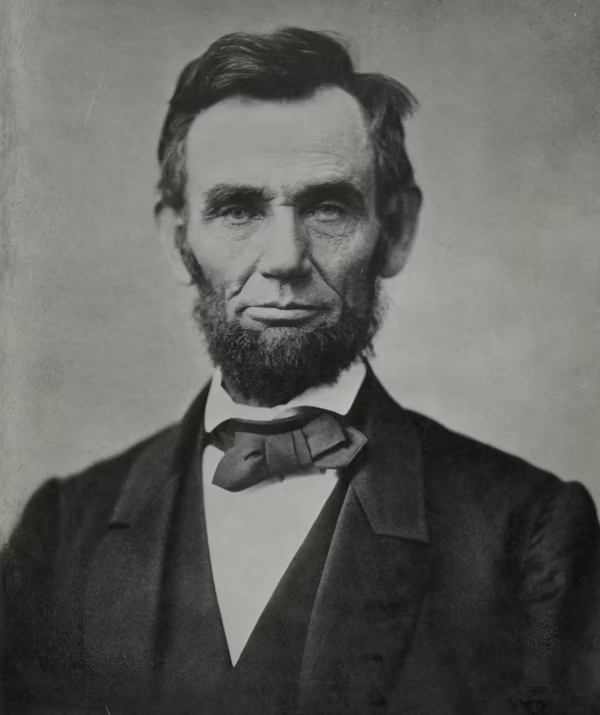
Senate candidate for the State of Illinois, Abraham Lincoln, was addressing the Illinois Republican Convention. He spoke these words on this day in 1858. And it was these words that would cost Lincoln the election.
Lincoln went on to wisely observe, “I do not expect the Union to be dissolved – I do not expect the house to fall – but I do expect it will cease to be divided. It will become all one thing, or all the other.”2
These words were an attack on his democratic opponent, Stephen A. Douglas, who believed that the issue of slavery was a decision best left to the sovereignty of a state. “After Lincoln’s speech, several of his friends expressed dismay at its “radical” content. Leonard Swett, a lawyer and friend of Lincoln’s, later wrote that Lincoln’s talk of using federal power to end slavery was “unfortunate and inappropriate,” although Swett admitted that in retrospect Lincoln was ultimately correct.”3
While I could easily write the devotional on the topic of Lincoln’s speech, I’d rather focus on the phrase he used: A house divided against itself cannot stand. Where did he get this?
Matthew 12:22-25 says, “Then was brought unto him one possessed with a devil, blind, and dumb: and he healed him, insomuch that the blind and dumb both spake and saw. (23) And all the people were amazed, and said, Is not this the son of David? (24) But when the Pharisees heard it, they said, This fellow doth not cast out devils, but by Beelzebub the prince of the devils. (25) And Jesus knew their thoughts, and said unto them, Every kingdom divided against itself is brought to desolation; and every city or house divided against itself shall not stand.”
The Pharisees’ accusation against Jesus was illogical. If Jesus was “casting out Satan’s demons by the power of Satan, then Satan was working against himself. This would be absurd.” (Believer’s Bible Commentary)
Jesus would go on to use this Pharisaical setup to teach something vitally important. “Wherefore I say unto you, All manner of sin and blasphemy shall be forgiven unto men: but the blasphemy against the Holy Ghost shall not be forgiven unto men. (32) And whosoever speaketh a word against the Son of man, it shall be forgiven him: but whosoever speaketh against the Holy Ghost, it shall not be forgiven him, neither in this world, neither in the world to come.” (Matthew 12:31-32)
There are those who reject Jesus out of ignorance. Saul of Tarsus was one of those (1 Timothy 1:13) and this sin can be forgiven. But, willfully rejecting the revelation of Jesus – especially that which was confirmed by miracles and observed firsthand by the Pharisees – was unpardonable. It was blasphemy against the Holy Spirit of God, the conviction that the Spirit had given.
Can and does this sin get committed today? I believe that it does. John 16:7-11 says, “Nevertheless I tell you the truth; It is expedient for you that I go away: for if I go not away, the Comforter will not come unto you; but if I depart, I will send him unto you. (8) And when he is come, he will reprove the world of sin, and of righteousness, and of judgment: (9) Of sin, because they believe not on me; (10) Of righteousness, because I go to my Father, and ye see me no more; (11) Of judgment, because the prince of this world is judged.” Though we don’t have Jesus in the flesh doing miracles like the Pharisees saw, we have the Holy Spirit who indwells the believer and who has come to bring conviction to the world concerning the identity of Jesus. To reject that conviction is to blaspheme the Holy Spirit. Once the sin has been committed in finality, there is no reversing it. That’s why Jesus will be justified to say one day, “Depart from Me, I never knew you.”
Is the Holy Spirit knocking at your heart’s door today? Don’t turn Him away. Revelation 3:20 calls to you! “Behold, I stand at the door, and knock: if any man hear my voice, and open the door, I will come in to him, and will sup with him, and he with me.”
Images are taken from https://pixabay.com/, https://www.pexels.com/, or https://unsplash.com/images or created in Windows Copilot. According to the websites, they are Royalty Free and free to be used for our purposes.
1https://www.nps.gov/liho/learn/historyculture/housedivided.htm
2Ibid.
3https://www.history.com/this-day-in-history/june-16/lincoln-warns-that-america-is-becoming-a-house-divided
