

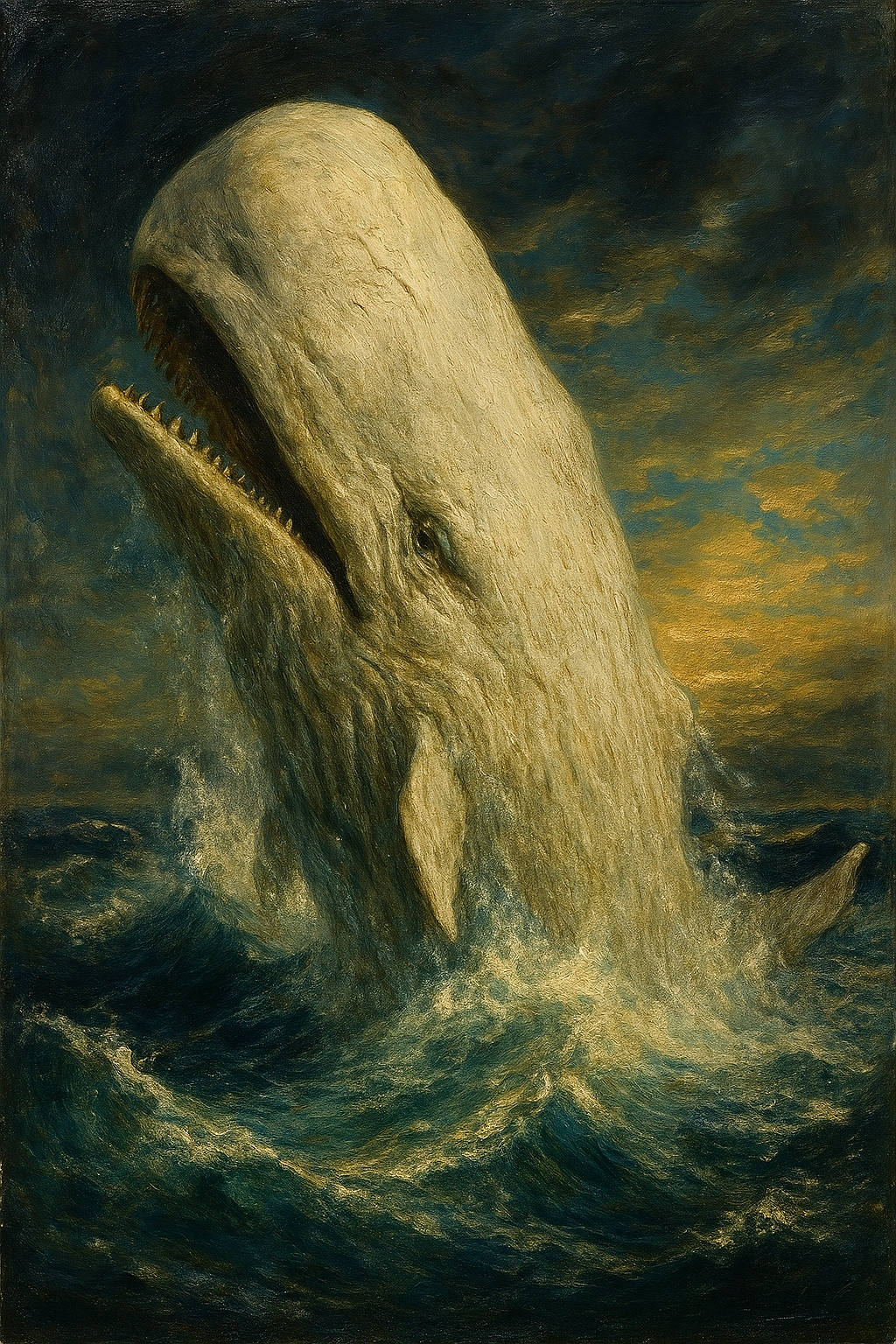
 “Call me Ishmael. Some years ago—never mind how long precisely—having little or no money in my purse, and nothing particular to interest me on shore, I thought I would sail about a little and see the watery part of the world. It is a way I have of driving off the spleen and regulating the circulation. Whenever I find myself growing grim about the mouth; whenever it is a damp, drizzly November in my soul; whenever I find myself involuntarily pausing before coffin warehouses, and bringing up the rear of every funeral I meet; and especially whenever my hypos get such an up per hand of me, that it requires a strong moral principle to prevent me from deliberately stepping into the street, and methodically knocking people’s hats off—then, I account it high time to get to sea as soon as I can.”1
These are the opening words to the classic Moby Dick, written by Herman Melville and published in America on this day in 1851. One month earlier, it was published in London. Melville had promised his publisher an adventure novel. Drawing from his experiences in the merchant marines, the U.S. Navy, and on a whaling ship, Melville created the story of Ishmael, a sailor who joins Captain Ahab’s crew in a vengeful search for the whale, Moby Dick, that has come to represent all that is wicked and evil. Several themes run throughout the novel: obsession and revenge; man vs. nature; fate vs. free will. Ahab would eventually lose his life, caught in the rope of the harpoon intended for Moby Dick. Hung and drowned, the only survivor was Ishmael, left to tell the tale.
While the novel sounds exciting, it was met with great criticism. The sophisticated British reviewers had great influence over the American reviewers. “We have read nearly one half of this book, and are satisfied that the London Athenaeum is right in calling it ‘an ill-compounded mixture of romance and matter-of-fact.'” Though the Post quoted the greater portion of the review, it omitted the condensed extract of Melville’s prose the Athenaeum had included to give readers an example of it. The Post deemed the price of one dollar and fifty cents far too much: “‘The Whale’ is not worth the money asked for it, either as a literary work or as a mass of printed paper”.2
Even though Melville kept writing, his literary efforts couldn’t pay the bills. He spent the last 20 years of his life in America working as a customs inspector. He would die in 1891, never hearing the praise or knowing that by the 1920s, his book would be considered a great piece of literature and continue as a staple reading assignment in high schools and universities across the country.
This presents a sad truth for many of our lives. We have no idea what our legacy will be at the time of our death. We have no concept of how far reaching our impact might be. While many will leave this world with buildings bearing their name or discoveries named after them, that’s only a legacy of material things. We should desire to leave something more significant and lasting. Acts 9:36-39 tells the story of someone with a great legacy.
“Now there was at Joppa a certain disciple named Tabitha, which by interpretation is called Dorcas: this woman was full of good works and almsdeeds which she did. (37) And it came to pass in those days, that she was sick, and died: whom when they had washed, they laid her in an upper chamber. (38) And forasmuch as Lydda was nigh to Joppa, and the disciples had heard that Peter was there, they sent unto him two men, desiring him that he would not delay to come to them. (39) Then Peter arose and went with them. When he was come, they brought him into the upper chamber: and all the widows stood by him weeping, and shewing the coats and garments which Dorcas made, while she was with them.”
Though not specifically worded this way, Dorcas is remembered for how she loved and cared for people, specifically the widows. They brought their treasures, the expressions of that legacy. Her “good works and almsdeeds” would be remembered but not just for the works but for the compassionate soul that did these kind gestures.
Another great legacy was mentioned to Timothy in 2 Timothy 1:3-5. Paul said, “I thank God, whom I serve from my forefathers with pure conscience, that without ceasing I have remembrance of thee in my prayers night and day; (4) Greatly desiring to see thee, being mindful of thy tears, that I may be filled with joy; (5) When I call to remembrance the unfeigned faith that is in thee, which dwelt first in thy grandmother Lois, and thy mother Eunice; and I am persuaded that in thee also.”
Lois and Eunice had left a spiritual legacy. It had been implanted in Timothy by the grace of God. Paul is thinking about these great women and their legacy that is standing before him.
Did these people set out to leave a legacy? Was that what motivated them? Probably not. But because they were faithful to the Lord and desiring to serve Him, they left a legacy that cannot be measured in dollars and cents. Will that be said of us someday?
 A lasting legacy can be given if we live by the words written by Asaph in Psalms 78:2-7. “I will open my mouth in a parable: I will utter dark sayings of old: (3) Which we have heard and known, and our fathers have told us. (4) We will not hide them from their children, shewing to the generation to come the praises of the LORD, and his strength, and his wonderful works that he hath done. (5) For he established a testimony in Jacob, and appointed a law in Israel, which he commanded our fathers, that they should make them known to their children: (6) That the generation to come might know them, even the children which should be born; who should arise and declare them to their children: (7) That they might set their hope in God, and not forget the works of God, but keep his commandments.”
1https://dn721606.ca.archive.org/0/items/collected-novels/moby-dick.pdf
2https://en.wikipedia.org/wiki/Moby-Dick#Reception
Images are taken from https://pixabay.com/, https://www.pexels.com/, or https://unsplash.com/images or created in Windows Copilot. According to the websites, they are Royalty Free and free to be used for our purposes.
