

 Thou shalt not kill. Thou shalt not steal. Thou shalt not commit adultery. Thou shalt not spit. Whoa! I don’t remember that in the Ten Commandments. While “thou shalt not spit” can’t be found on the tablets of stone, it was codified into New York law.
Spitting is a gross, nasty habit. It must have been worse in 1896. I’m certain that men committed 99.9% of the offensive spitting issues. Even today, you seldom see a woman spit. Signage from the era called it “careless spitting” and warns that fines will be issued to those “spitting on the floor of the car,” referring to the trolley cars and public transportation.
Though it exudes boorish etiquette, why would it have become illegal?
“In the 19th century, tuberculosis killed one in every seven people in Europe and the U.S., and it was particularly deadly for city dwellers. Between 1810 and 1815, the disease—then commonly known as consumption, or the white plague—was to blame for more than a quarter of the recorded deaths in New York City.”
“In the 19th century, tuberculosis [was] the greatest single cause of death among New Yorkers,” explains Anne Garner, the curator of rare books and manuscripts at the New York Academy of Medicine Library and the co-curator of the Museum of the City of New York’s new exhibition, “Germ City: Microbes and the Metropolis.”1
“By 1900, approximately 150,000 Americans succumbed to consumption each year, while over one million more were infected. Although the poor suffered most acutely, tuberculosis struck families of all social and economic classes. From New England to California, it cast a pall upon the neighborhoods, workplaces, schools and homes where it appeared.”2
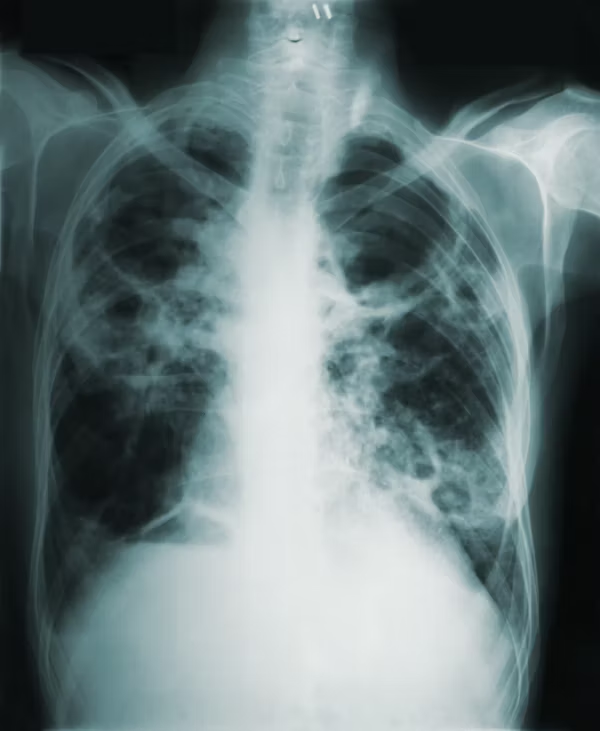
Dr. Robert Koch is credited with discovering the cause of tuberculosis. It was a bacterium later designated as Mycobacterium tuberculosis. Since tuberculosis is a respiratory disease, the transmission of the disease happened during coughing which produces sputum, a mixture of phlegm and spit. What do you do when you are hacking up your lungs? You spit, thus spitting the contagion.
An advertisement published by the Siegel Cooper Company stated:
Consumption is “caught” mainly through the spit of consumptives.
Friends of consumption: Dampness, Dirt, Darkness, Drink
Enemies of consumption: Sun, Air, Good Food, Cleanliness
“So in 1896, forward-thinking New York became the first city to outlaw “expectorating,” as the practice was delicately called in the gay nineties. Signs went up on public transportation and other spitting hot spots, warning of arrest and a $500 fine. But the new ordinance generated controversy and wasn’t always taken seriously.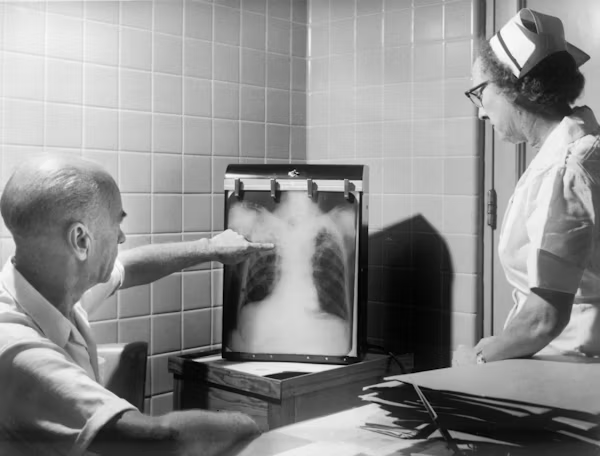
“In New York, of the 2,513 arrested, there were 2,099 convicted, one of every seven escaping,” writes a 1910 New York Times article. The total fines were $1,936.80, an average of less than $1.”3
When the anti-spitting law was passed, tuberculosis accounted for 25% of all deaths.4 Such a little, disgusting habit could have been the cause of thousands contracting a disease. Isn’t it amazing how dangerous such a small thing can be?
Song of Solomon 2:15 warns, “Take us the foxes, the little foxes, that spoil the vines: for our vines have tender grapes.” We have a tendency to categorize sin as BIG sin and LITTLE sin, thinking the little sins are just minor infractions without repercussions.
Let’s not forget, though, that Lot’s wife turned into a pillar of salt and all she did was glance back at her home from which she was fleeing. Moses was forbidden entrance to Canaan because he struck a rock in anger instead of speaking to it. Achan died because he took some of the trinkets and baubles of Jericho as it crumbled. And Uzzah died because he touched the Ark of the Covenant, attempting to stabilize it from the bumpy ride on the cart pulled by the oxen.
It would seem that there are no “little” sins, especially when you consider that Jesus died for all sin. His death wasn’t suffered in greater agony or needed more for the big sins versus the little sins. Jesus was crucified with ALL sins applied to him.
When tempted to feel justified about “little” sins, think about the dangers in the 1800s just from spitting. And recall 2 Corinthians 5:21. “For he hath made him to be sin for us, who knew no sin; that we might be made the righteousness of God in him.”
1https://www.mentalfloss.com/article/561579/tuberculosis-anti-spitting-campaigns
2https://scholarworks.umt.edu/cgi/viewcontent.cgi?article=5498&context=etd
3https://ephemeralnewyork.wordpress.com/tag/anti-spitting-laws/
4https://www.medicalnewstoday.com/articles/tuberculosis-history#faq
Images are taken from https://pixabay.com/, https://www.pexels.com/, or https://unsplash.com/images or created in Windows Copilot. According to the websites, they are Royalty Free and free to be used for our purposes.
