

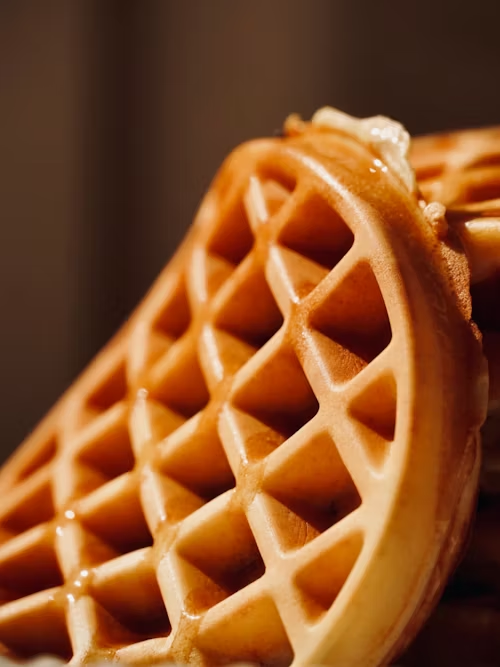
 Breakfast foods are the best, aren’t they? Scrambled eggs. Loaded omelets. Bagels slathered in cream cheese. Coffee cakes. Yogurt parfaits. Oatmeal and cereals. Biscuits and gravy. Sausage links and bacon. Toast with butter and jelly.
And the stars of the show: pancakes and waffles! Which do you prefer? What’s the difference besides their look? Well, for starters, waffles have twice the fat and sugar of pancakes, giving them their crispiness. And today isn’t National Pancake Day. It’s National Waffle Day.
What’s your favorite waffle topping? Some are purists, adding just butter and maple syrup. Others top with fruit or a strudel glaze. My personal favorite is peanut butter with syrup. A hot waffle melts the peanut butter and with the added sweetness of the syrup, your eyes will roll to the back of your head with delight! Try it!
During the 14th c., the first waffle recipes were penned by a French husband for his wife. She was to take the ingredients and “fill, little by little, two irons at a time with as much of the paste as a slice of cheese is large. Then close the iron and cook both sides. If the dough does not detach easily from the iron, coat it first with a piece of cloth that has been soaked in oil or grease.”1
“The Dutch were particularly fond of wafles and colonists introduced them to the New World in the early 17th century. (It was in the New World that these cakes met their perfect companion, maple syrup.) By 1735, the word gained an extra “f,” becoming waffle as we we know it today. Thomas Jefferson is said to have brought the first long-handled waffle iron to America in 1789.”2 Thank you, Dutch people!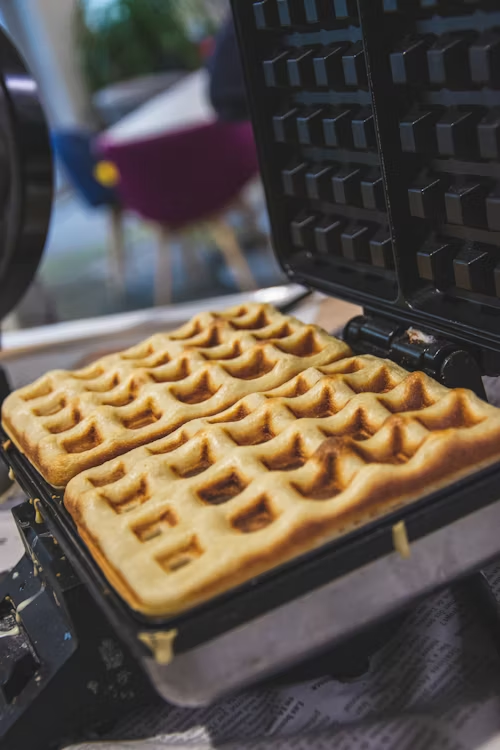
The modern stove top waffle iron with its distinct pattern was invented on this day in 1869, by Cornelius Swarthout of Troy, New York. General Electric picked up the patent and started mass producing waffle irons in 1911.3 Today, about the only time you see a waffle iron in use is at the hotel breakfast bars or at campsites. The last time we camped, the lady next to us was fixing her family homemade waffles for breakfast. While I’m tearing down our campsite, the smells of those waffles wafted through the air, of course, in my direction. What a heavenly aroma! Do you suppose one of those delicious waffles were offered? Yeah, right!
Waffle as a noun is a good thing. Waffle as a verb? Not so much. In 1690, it meant “to yelp, bark like a puppy.” That’s not bad. However, by c. 1700, it took on the figurative sense of “talking foolishly” which led to the word meaning “vacillate, equivocate” (1803), originally a Scottish and northern English usage.”4
To vacillate means to waver in mind, will, or feeling : hesitate in choice of opinions or courses. To equivocate means to use equivocal language especially with intent to deceive; to avoid committing oneself in what one says.5
Tomorrow, as you gather at church, we will not waffle. We will practice 2 Timothy 4:2 and “Preach the word; be instant in season, out of season; reprove, rebuke, exhort with all longsuffering and doctrine.” We will, “Therefore, brethren, stand fast, and hold the traditions which ye have been taught, whether by word, or our epistle.” (2 Thessalonians 2:15) We will strive to obey the instructions of 1 Corinthians 16:13, “Watch ye, stand fast in the faith, quit you like men, be strong.” Our desire will be to exemplify 1 Corinthians 15:58. “Therefore, my beloved brethren, be ye stedfast, unmoveable, always abounding in the work of the Lord, forasmuch as ye know that your labour is not in vain in the Lord.”
 Waffles are great for breakfast – or anytime of the day. But we cannot be wafflers. We must know where we stand and why we stand there. We cannot allow ourselves to “… children, tossed to and fro, and carried about with every wind of doctrine, by the sleight of men, and cunning craftiness, whereby they lie in wait to deceive.” (Ephesians 4:14)
In this day of compromise, vacillation, and equivocation, the Christian needs to be an unbending believer. Take to heart and live out Galatians 5:1. “Stand fast therefore in the liberty wherewith Christ hath made us free, and be not entangled again with the yoke of bondage.”
1https://www.nationaldaycalendar.com/national-day/national-waffle-day-august-24
2https://www.thekitchn.com/from-wafers-to-cones-a-short-h-113627
3https://www.nationaldaycalendar.com/national-day/national-waffle-day-august-24
4https://www.etymonline.com/word/waffle
5https://www.merriam-webster.com/dictionary/equivocate
Images are taken from https://pixabay.com/, https://www.pexels.com/, or https://unsplash.com/images or created in Windows Copilot. According to the websites, they are Royalty Free and free to be used for our purposes.
