
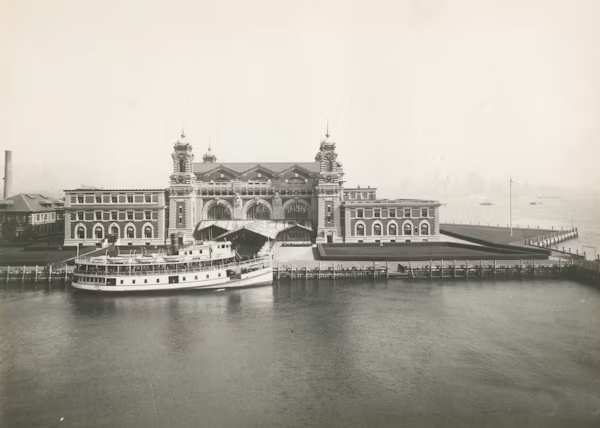
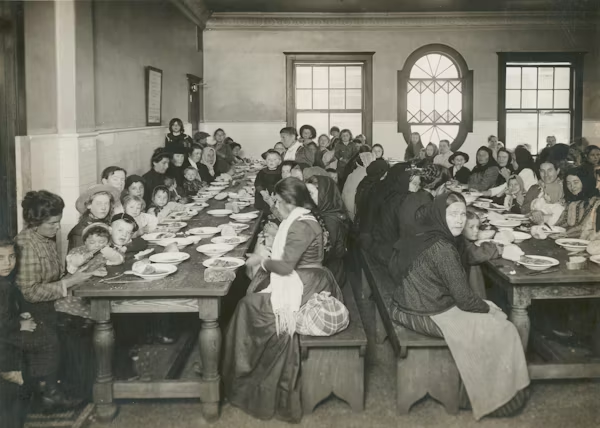
 At the mouth of the Hudson River and located between New York and New Jersey is Ellis Island. From 1892 to 1954, it served as an immigration reception center, processing over 12 million people1 who came here from Italy, Russia, Ireland, Austria-Hungry, Germany, the UK, Greece, Poland, and many other places.2 Nearly 3 million of the 12 million were Jews.3
The immigration process went something like this: “Before the ship was allowed to enter into New York Harbor, according to Barry Moreno, historian and librarian at the Ellis Island Immigration Museum, it had to stop at a quarantine checkpoint off the coast of Staten Island where doctors would look for dangerous contagious diseases such as smallpox, yellow fever, plague, cholera and leprosy. Once the ship passed inspection, immigration officers began boarding the ship via rope ladders, before it docked.
“They had to start immigration procedures really fast because there were so many passengers—often as many as 2,000 to 3,000 passengers from all classes,” Moreno says. “You could have as many as 1,500 passengers in third class alone…”
First up, was a medical examination performed by military surgeons, according to Moreno. “Because they were dressed as military men, it often puzzled and confused immigrants, who were mostly peasants, poor Jews or small townspeople,” he says. “They didn’t understand who these men were. They thought they were policemen or soldiers. But as these long, long endless lines formed, the doctors had to examine everyone, as quickly as possible, for eye disease, skin disorders, heart disease and more.”
The doctors also had to know a few words of instruction in many languages. “Most of the immigrants were illiterate even in their own languages,” Moreno notes. “And by 1907, the doctors had already developed a secret code system using a piece of chalk. They would mark the passenger’s clothes with a letter of the alphabet: ‘H’ indicated heart trouble suspected; ‘L’ suspected lameness; ‘X’ suspected feeble-mindedness, and so on.”
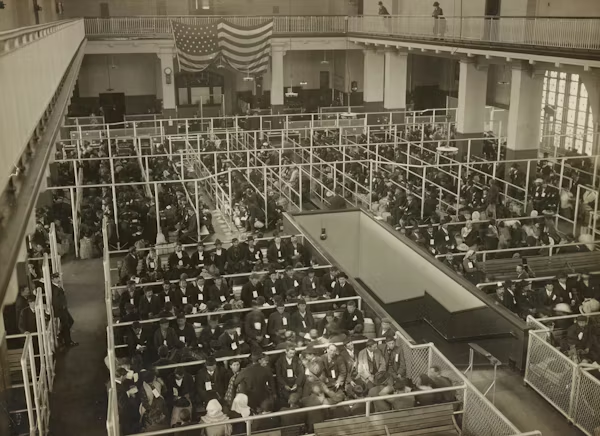
Those marked, Moreno says, were removed from the line and “taken across the room where you were locked in a pen, a cage, called the doctor’s pen” until the doctors were free to continue further examinations or questioning.
“Only about 10 percent of people were detained for this kind of questioning,” he says. “Ninety percent got through this line of questioning without any problem. Why? Partly because the doctors knew there wasn’t enough space to detain too many people.”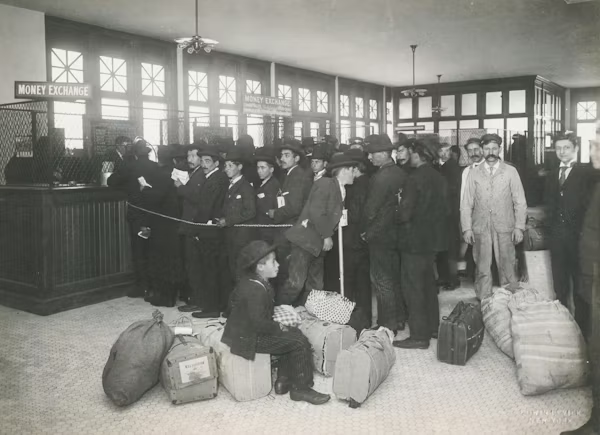
Next, immigrants were filtered into long lines to be interviewed by inspectors (often with the help of interpreters). “The inspector would verify the passenger manifest by rereading the information provided,” Moreno says. “If everything was OK, he would just make a little check mark by your name, but if your answers were bad, wrong or suspicious, or if secret information had arrived about you previous to your arrival, your name was marked with an ‘X’ and you were told you would be detained…”
“Just 2 percent of immigrants at Ellis Island were denied entry to the United States. “The great contradiction or irony here is that you have a massive inspection process, and you have this restrictionist sentiment and all these people you want to keep out of the country and, at the end of the day, less than 2 percent are rejected,” says Vincent Cannato, associate professor of history at the University of Massachusetts, Boston, and author of American Passage: The History of Ellis Island.. “At end of day, the process was not really to keep lots of people out; the goal really was to sift out the wheat from the chaff and sift out those who were ‘undesirable.’”4
On this day in 1907, Ellis Island processed the largest number of immigrants: 11,747. This more than doubled the daily average of 5,000 immigrants.
Ellis Island is the place where foreigners became family. Well, that’s probably not true for the first generation foreigners on the island but this is definitely true for the generations of individuals who can trace their roots back to the first immigrants. In fact, it is estimated that 40% of all Americans can trace their roots back to Ellis Island.5 It’s quite possible that some of the readers of this devotional are here because of ancestors that came to that island a long time ago.
 Did you realize that every Christian is an “immigrant” in a sense? Ephesians 2:12 says, “That at that time ye were without Christ, being aliens from the commonwealth of Israel, and strangers from the covenants of promise, having no hope, and without God in the world.” Ephesians 2:19 goes on to say, “Now therefore ye are no more strangers and foreigners, but fellowcitizens with the saints, and of the household of God.”
Notice the words that the Bible uses that are still used today to speak of people who are not “nationals:” aliens, strangers, foreigners. However, there is a big difference. Only 2% were rejected from Ellis Island. 100% of foreigners, aliens, and strangers are rejected from Heaven. We are all deemed unworthy. As the Heavenly immigration board assess humanity, the decision is written in Romans 3:10-12. “As it is written, There is none righteous, no, not one: (11) There is none that understandeth, there is none that seeketh after God. (12) They are all gone out of the way, they are together become unprofitable; there is none that doeth good, no, not one.” Notice the emboldened words. It’s an open and shut case.
Or is it?
Ephesians 2:13-18 says, “But now in Christ Jesus ye who sometimes were far off are made nigh by the blood of Christ. (14) For he is our peace, who hath made both one, and hath broken down the middle wall of partition between us; (15) Having abolished in his flesh the enmity, even the law of commandments contained in ordinances; for to make in himself of twain one new man, so making peace; (16) And that he might reconcile both unto God in one body by the cross, having slain the enmity thereby: (17) And came and preached peace to you which were afar off, and to them that were nigh. (18) For through him we both have access by one Spirit unto the Father.”
Everyone wants to go to Heaven but the only way off the island called Earth and into the gloriousness of eternity is through someone making us worthy of Heaven. That someone is Jesus Christ.
 2 Corinthians 5:21 reminds us, “For he hath made him to be sin for us, who knew no sin; that we might be made the righteousness of God in him.” Jesus makes lost sinners worthy of Heaven by making them righteous, cleaning them from the inside out and making them a “new creature.” (2 Corinthians 5:17)
Once our immigration status is processed (immediately at conversion), the designation of foreigner, stranger, or alien is removed. Now, there is only the family joy of Galatians 3:26-28, “For ye are all the children of God by faith in Christ Jesus. (27) For as many of you as have been baptized into Christ have put on Christ. (28) There is neither Jew nor Greek, there is neither bond nor free, there is neither male nor female: for ye are all one in Christ Jesus.”
1https://www.loc.gov/classroom-materials/immigration/italian/ellis-island/
2https://www.historytools.org/stories/ellis-island-immigration-gateway-to-america#google_vignette
3https://tamidnyc.org/61-ellis-island-coming-america/
4https://www.history.com/articles/immigrants-ellis-island-short-processing-time
5https://www.history.com/articles/ellis-island
Images are taken from https://pixabay.com/, https://www.pexels.com/, or https://unsplash.com/images or created in Windows Copilot. According to the websites, they are Royalty Free and free to be used for our purposes.
