

 Today, we are getting back to our normal random topics and leaving Alaska. Several of the sources I use for illustrations are dated with events recorded from that particular day. Let’s go back to events from last week and see how they can lead us to applying some Biblical truths.
On August 4, 1790, Secretary of the Treasury Alexander Hamilton established a group known as the Revenue Marine Service. Ten ships patrolled the eastern seaboard to enforce the payment of tariffs from foreign ships. In 1863, the name was changed to the Revenue Cutter Service, an acknowledgement of Congress’s authorization for the creation of cutters to fulfill this mission.
Through the Act of March 2, 1799, President Lincoln ordered the Revenue Cutter Service into combat duty. They were to report directly to the Navy.
From here, the historical details begin to merge. Along the east coast during the 1700s to early 1800s, volunteers began forming lifesaving stations manned with boats for water rescue operations. In 1848, Congress appropriated funds to help the lifesaving stations and placed them under the administration of the Revenue Marine Service. The lifesaving stations were organized as the U.S. Lifesaving Service. Then, in 1915, per 14 U.S.C. § 101, the Coast Guard was formed by the official merger of the U.S. Lifesaving Service and the Revenue Cutter Service. “The Coast Guard as established January 28, 1915, shall be a military service and a branch of the armed forces of the United States at all times.”
“In 1939 the United States Lighthouse Service (another entity) was merged into the Coast Guard. The Coast Guard itself was moved to the Department of Transportation in 1967, and on 1 March 2003 it became part of the Department of Homeland Security. However, under 14 U.S.C. § 3 as amended by section 211 of the Coast Guard and Maritime Transportation Act of 2006, upon the declaration of war and when Congress so directs in the declaration, or when the president directs, the Coast Guard operates as a service in the Department of the Navy.”1
Today is National Coast Guard Day, honoring the conception of what was to become the United States Coast Guard. To any who served in this branch, Happy Birthday and thank you for your service.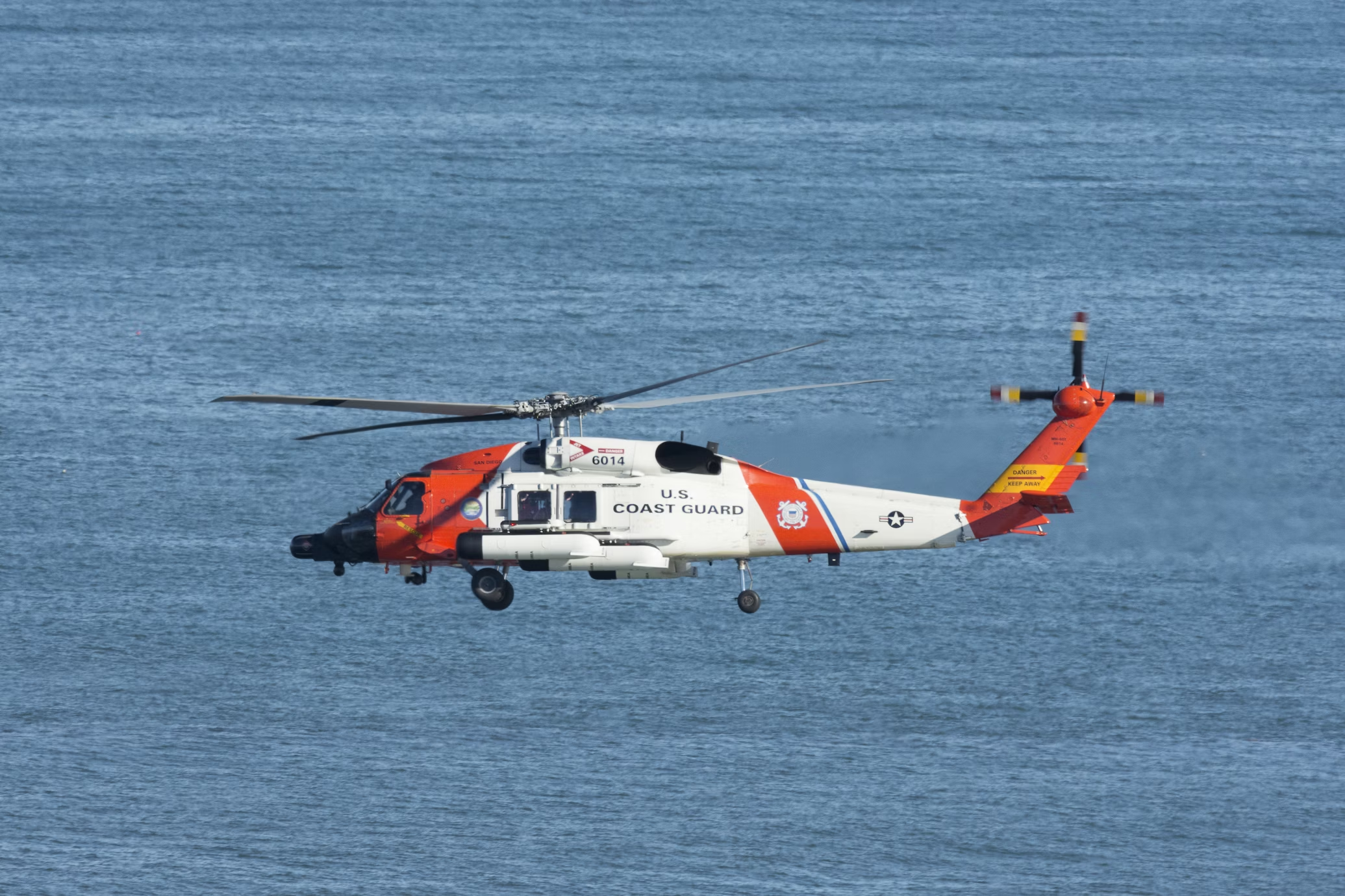
Thinking back to our Alaskan adventure, we were in many ports and harbors. There was either a Coast Guard vessel or some other obvious rescue vessel ready to go into action to help those in need. If you were stranded on a broken-down vessel or worse, you were in the water, you would want someone to come to your rescue as fast as possible. You can only survive so long in the waters, holding on a life preserver, stranded in a lifeboat, or clinging to some piece of flotsam.
I wonder if the Apostle Paul wished for the Coast Guard.
Acts 27:13-14, 37, 41-44 tells the story. “And when the south wind blew softly, supposing that they had obtained their purpose, loosing thence, they sailed close by Crete. (14) But not long after there arose against it a tempestuous wind, called Euroclydon…And we were in all in the ship two hundred threescore and sixteen souls…And falling into a place where two seas met, they ran the ship aground; and the forepart stuck fast, and remained unmoveable, but the hinder part was broken with the violence of the waves. (42) And the soldiers’ counsel was to kill the prisoners, lest any of them should swim out, and escape. (43) But the centurion, willing to save Paul, kept them from their purpose; and commanded that they which could swim should cast themselves first into the sea, and get to land: (44) And the rest, some on boards, and some on broken pieces of the ship. And so it came to pass, that they escaped all safe to land.”
Reading the verses I left out, you find that this was a storm that lasted over 14 days! I can’t imagine what one day must have felt like aboard the ship.
I prefaced the above scripture with a thought: I wonder if the Apostle Paul wished for the Coast Guard. The answer to that is no! He had something far better.
Today, you might be going through a storm. I’m not suggesting that the Lord is going to respond to you exactly as He did to Paul. But I can promise you, the Lord will respond to the cry of His child. Read the closing verses and take comfort in knowing that God will see you through any storm that may come your way.
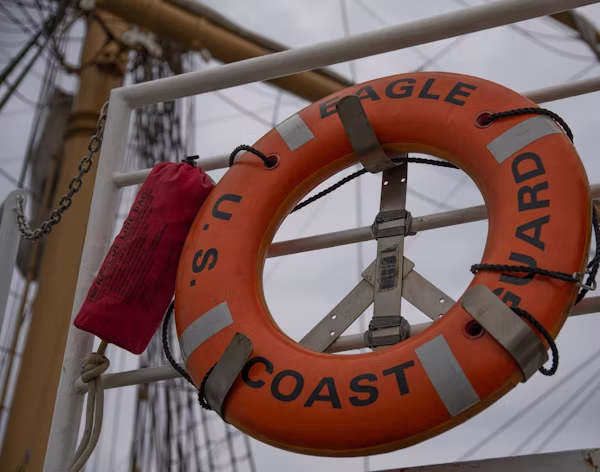 Acts 27:21-25 says, “But after long abstinence Paul stood forth in the midst of them, and said, Sirs, ye should have hearkened unto me, and not have loosed from Crete, and to have gained this harm and loss. (22) And now I exhort you to be of good cheer: for there shall be no loss of any man’s life among you, but of the ship. (23) For there stood by me this night the angel of God, whose I am, and whom I serve, (24) Saying, Fear not, Paul; thou must be brought before Caesar: and, lo, God hath given thee all them that sail with thee. (25) Wherefore, sirs, be of good cheer: for I believe God, that it shall be even as it was told me.”
1https://en.wikipedia.org/wiki/History_of_the_United_States_Coast_Guard
Images are taken from https://pixabay.com/, https://www.pexels.com/, or https://unsplash.com/images or created in Windows Copilot. According to the websites, they are Royalty Free and free to be used for our purposes.
The Revenue Cutter Service image is public domain and courtesy of http://www.uscg.mil/.
