

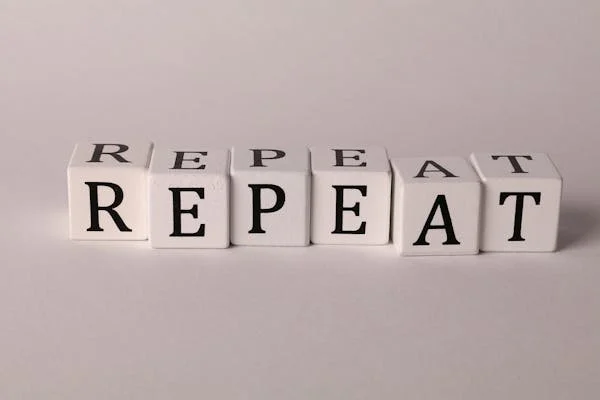
 Charles Caleb Colton is credited with originating a familiar phrase in 1820. In his book Lacon: or, Many things in few words (sic), he used the phrase, “Imitation is the sincerest form of flattery.” I don’t think most siblings would agree!
The older sister isn’t impressed when the younger sister dresses like her.
The older brother doesn’t want the younger brother tagging along, trying to do what the older brother is doing.
And if one sibling wants to get the other sibling fired up mad, just repeat everything they said, right down to vocal inflections and mannerisms.
Today is National Repeat Day. The origin of the celebration cannot be found even though it is on the National Day Calendar registry.
Repetition doesn’t have to be something that is annoying. There are times when a bit of repetition is a very good idea. For instance, repeating a “thank you” two or three different times (not in a row) for a gift or act of kindness might be a way to express not only your gratitude but how much you have really enjoyed the gift.
What about repeating your proofreading of an email before you send it? You might catch some errors or think of a better way to say something. I always proofread the devotionals before printing them, yet I will still catch mistakes after they are printed. Repeating the proofing might be helpful.
I don’t mind repeating a favorite song, listening to it several times. The same is true for a favorite television show or series.
Scientists from all fields herald the value of repetition. Repetition helps create habits. It “fosters cognitive fluency, making information easier to process.”1 It is the key to neuroplasticity. Repetition helps us retain memories. It also is comforting.
Repetition is definitely a valuable thing with spiritual matters. Paul said in Philippians 3:1, “Finally, my brethren, rejoice in the Lord. To write the same things to you, to me indeed is not grievous, but for you it is safe.” Peter voiced a similar thought in 2 Peter 3:1-2. “This second epistle, beloved, I now write unto you; in both which I stir up your pure minds by way of remembrance: (2) That ye may be mindful of the words which were spoken before by the holy prophets, and of the commandment of us the apostles of the Lord and Saviour.”
One of the biggest dangers and self-deceptions is the attitude of a know-it-all. When we roll our eyes, sigh, and say, “I’ve heard this before,” we are denying the safety and value of repetition. Peter goes on to show us what that value is.
“Knowing this first, that there shall come in the last days scoffers, walking after their own lusts, (4) And saying, Where is the promise of his coming? for since the fathers fell asleep, all things continue as they were from the beginning of the creation.” (2 Peter 3:3-4)
The scoffers and skeptics will disparage what we believe. Repetitively studying and reapplying the truths of God’s Word will keep their comments from causing us to wobble in our faith. We will be ready with an answer. Repetition helped make us solid and grounded in our faith. It helped us learn and memorize the truth.
 Our minds must constantly be stirred and reminded of Biblical truths, whether it be precepts, principles, or stories. There is always something to learn, something to reapply, and something to which we should commit. God’s Word never gets old and is always worth repeating.
“If thou put the brethren in remembrance of these things, thou shalt be a good minister of Jesus Christ, nourished up in the words of faith and of good doctrine, whereunto thou hast attained.” (1 Timothy 4:6)
1https://psychuniverse.com/science-behind-repetition/
Images are taken from https://pixabay.com/, https://www.pexels.com/, or https://unsplash.com/images or created in Windows Copilot. According to the websites, they are Royalty Free and free to be used for our purposes.
