

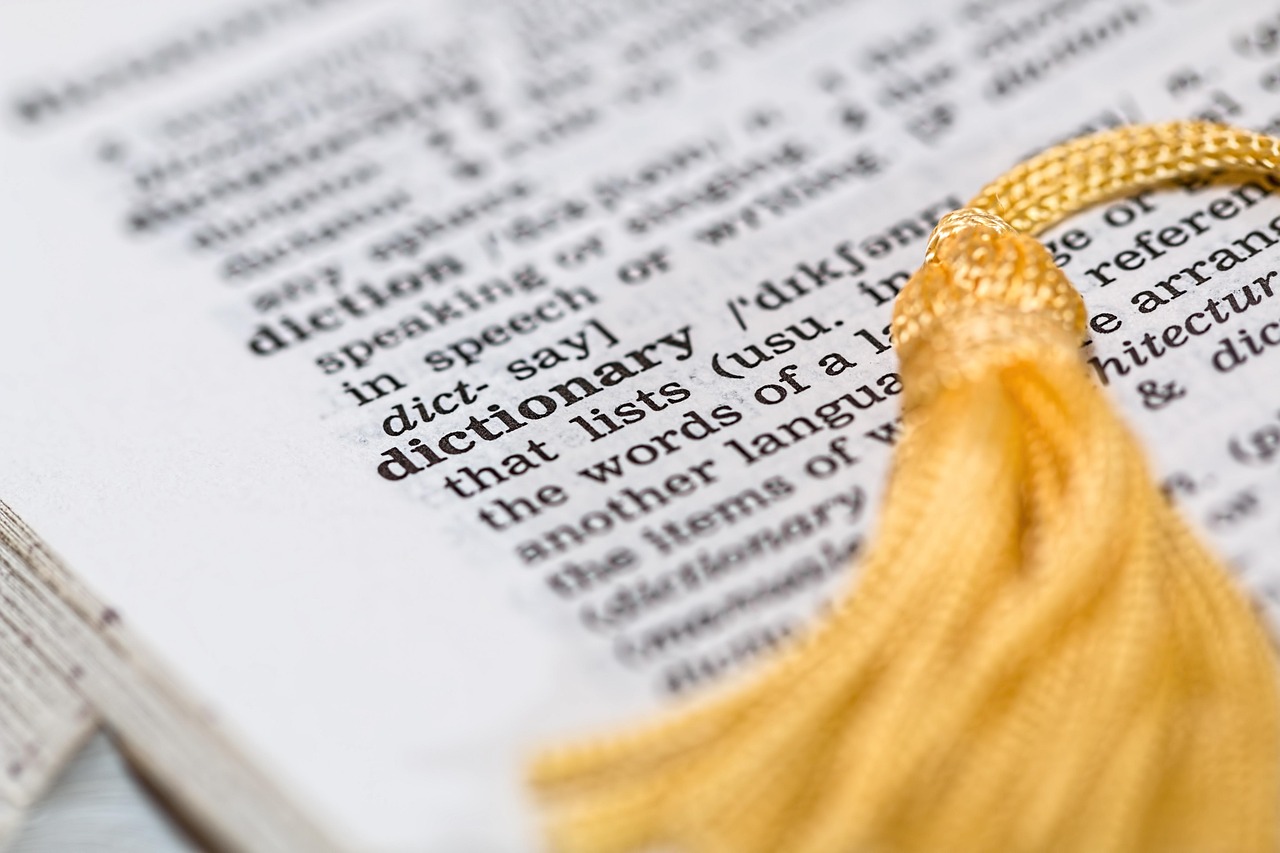
 The word dictionary is synonymous with the name Daniel Webster. We can’t think of one without the other and since today is National Dictionary Day, we will honor both the man and the book today which coincides with Noah Webster’s birthday in 1758.
“In 1806, American Noah Webster published his first dictionary, A Compendious Dictionary of the English Language. Webster immediately began compiling an expanded and fully comprehensive dictionary, An American Dictionary of the English Language in 1807.”1
Suppose you wanted to create a dictionary from scratch and didn’t have the benefit of Webster’s work. What would you do to get it going? Just consider Webster’s first steps. Realizing that the American vocabulary borrowed from other nations, he learned 26 different languages in order to understand the etymology of words. As he was doing this, he “collected” words and added them to the dictionary, a 27-year project.
So, who is the Merriam of the Merriam-Webster Dictionary. “In 1831, brothers George and Charles Merriam opened a printing and bookselling operation in Springfield, Massachusetts which they named G. & C. Merriam Co. The company, which was renamed Merriam-Webster, Incorporated, in 1982, has been in continuous operation since that time.
“Merriam-Webster can be considered the direct lexicographical heir of Noah Webster. In 1843, the company bought the rights to the 1841 edition of Webster’s magnum opus, An American Dictionary of the English Language, Corrected and Enlarged. At the same time, they secured the rights to create revised editions of the work. Since that time, Merriam-Webster editors have carried forward Noah Webster’s work, creating some of the most widely used and respected dictionaries and reference books in the world.”2
Each year, the American dictionary grows. While some words might be deleted due to them being archaic, there are many other words added. The Cambridge Dictionary was the most prolific, adding over 3,200 words.3 Dictionary.com added 327 new words, along with 173 new definitions and 1,228 revised definitions of words.4 Merriam-Webster only added 200.5 However, the hard-bound collegiate edition of Merriam-Webster added 5,000 new words and 1,000 new phrases and idioms !6
Now, sitting down and reading the dictionary isn’t exactly the most exciting thing we could do. It’s just a lot of words – a LOT! Even people who are readers wouldn’t find an afternoon curled up in their favorite chair with the dictionary to be very stimulating.
Think about your Bible for a moment. Boiling it down to the basic framework, the Bible is a book with a lot of words. 783,137 words. The Old Testament has 602,587 words while the New Testament has 180,550 words. In case you’re curious, the average adult reads between 200-250 words per minute (wpm). Let’s take the average of two numbers and say a person reads 225 wpm. It would take you 3,480.61 minutes to read the Bible. That is just over 58 hours or 2.42 days if you read continuously. If you took an hour each day to read the Bible, you could read the Bible in 58 days and if you started all over again once you finished, you could read the Bible over six times in a year. Now, that removes any intimidation from reading the Bible through in a year.
783,137 words is a LOT of words. But what makes those words different? 2 Timothy 3:16-17 says, “All scripture is given by inspiration of God, and is profitable for doctrine, for reproof, for correction, for instruction in righteousness: (17) That the man of God may be perfect, throughly furnished unto all good works.” “Inspiration of God” is one word in the Greek and the word means “God breathed.” Where is the first place in the Bible where it records that God breathed?
Genesis 2:7 says, “And the LORD God formed man of the dust of the ground, and breathed into his nostrils the breath of life; and man became a living soul.” God breathed life into the nostrils of dirt and it became a living soul. God breathed life into lifeless words and they became the living Word of God.
Hebrews 4:12 tells us, “For the word of God is quick, and powerful, and sharper than any twoedged sword, piercing even to the dividing asunder of soul and spirit, and of the joints and marrow, and is a discerner of the thoughts and intents of the heart.” Quick doesn’t mean that God’s Word is speedy – although the speed at which it brings conviction is lightning fast. The Greek word means to live, breathe, and to have true life.
Normally, I would close out with Scripture but today, I want to share quotes from Webster about the Bible. Noah Webster was a Christian man. His work will never be forgotten or minimized. But he knew that there was a far greater Work.
Education is useless without the Bible. The Bible was America’s basic text book in all fields. God’s Word, contained in the Bible, has furnished all necessary rules to direct our conduct.
All the miseries and evils which men suffer from vice, crime, ambition, injustice, oppression, slavery and war, proceed from their despising or neglecting the precepts contained in the Bible.
Our liberty, growth, and prosperity was the result of a Biblical philosophy of life. Our continued freedom and success is dependent on our educating the youth of America in the principles of Christianity.
The Bible must be considered as the great source of all the truth by which men are to be guided in government as well as in all social transactions.7
1https://www.nationaldaycalendar.com/national-day/national-dictionary-day-october-16
2https://www.merriam-webster.com/about-us/faq
3https://www.cambridge.org/news-and-insights/cambridge-dictionary-new-words-2024
4https://www.rd.com/article/new-words-dictionary-com/
5https://www.rd.com/list/new-words-dictionary/
6https://www.deseret.com/entertainment/2025/09/25/merriam-webster-dictionary-new-words/
7https://www.azquotes.com/quote/309596
Images are taken from https://pixabay.com/, https://www.pexels.com/, or https://unsplash.com/images or created in Windows Copilot. According to the websites, they are Royalty Free and free to be used for our purposes.
