

 Today is a celebration of that which is “holy” and that which is not. First, let’s consider the “holy” – I say that tongue in cheek! I know that there will be disagreement over this, especially from the health conscious, but I’m going to go out on the limb anyway. Today is National Paczki Day.
“A PUNCH-kee or POONCH-key or POOCH-key is traditionally a round Polish pastry filled with fruit and coated in sugar.”1 God bless the Polish for supplying us with this amazing treat. Quite honestly, though, you cannot get a good paczki in our area. Oh, there are those who try and they do their best. But if you want to know how they really taste, you have to go to a Polish community.
I fondly remember my introduction to the paczki. It was in Au Gres, Michigan. With a current population of less than a thousand and a land mass of just 2.38 sq. miles, in the early 90s, it had a national treasure: Lutz’s Bakery and Restaurant. While in our first full-time ministry, Au Gres wasn’t too far from the church and we had members in this town. They encouraged me to get one and I didn’t want to be rude. I complied! The first thing you notice is the weight of the pastry which was substantial. The filling was all throughout the pastry and you couldn’t take a bite without getting filling. Decadent is an accurate word to describe the paczki. I put this in the “holy” category because I’m certain God blessed my paczki. I did pray before I ate it and gave thanks, trying to fulfill 1 Corinthians 10:25-31.
Today is also Mardi Gras, a French word meaning Fat Tuesday. If you’ve ever seen pictures from Mardi Gras or heard what takes place, you know that this is anything but holy! “The tradition of Mardi Gras began as a Catholic observance, with roots in Europe, particularly in France. Mardi Gras marks the final day before Ash Wednesday, and is a time to enjoy rich food and festivities (hence, the creation of the paczki!) before the penitential season of Lent takes hold. In the days before refrigeration and modern methods of food preservation, this was also a time to use up or share all the nicer food items in Catholic households. This tradition was brought to Louisiana by French Catholic settlers, who adapted it to their new surroundings and unique cultural influences.”2
Lent, the 40-days of fasting that is supposed to mirror Jesus’ fasting in the wilderness before His temptation (Matthew 4) is in preparation for Easter. For 40 days, the celebrant chooses something from which to fast as a way to show repentance and to make penance for their sins. Easter calls for celebration and afterwards, you can resume that from which you fasted.
If Mardi Gras is about indulgence, Lent is about sacrifice. Does the Bible teach this?
First, looking at Mardi Gras and its definition, the indulgences tend to be very sinful. The Mardi Gras festival in New Orleans is all about partying, drinking, and women exposing themselves for trinkets and beads. KPLC channel 7 in Lake Charles, Louisianna interviewed Dr. LSU sociology professor Dr. Wesley Shrum. For years, he has been studying why people who normally wouldn’t behave like this choose to do so at this celebration. He was one of the authors of the academic journal “Ritual Disrobement at Mardi Gras: Ceremonial Exchange and Moral Order.”3 The intent and purpose behind Mardi Gras cannot find any support in Scripture. Just the opposite.
2 Peter 2:12-14 “But these, as natural brute beasts, made to be taken and destroyed, speak evil of the things that they understand not; and shall utterly perish in their own corruption; (13) And shall receive the reward of unrighteousness, as they that count it pleasure to riot in the day time. Spots they are and blemishes, sporting themselves with their own deceivings while they feast with you; (14) Having eyes full of adultery, and that cannot cease from sin; beguiling unstable souls: an heart they have exercised with covetous practices; cursed children.”
Galatians 5:16-17 “This I say then, Walk in the Spirit, and ye shall not fulfil the lust of the flesh. (17) For the flesh lusteth against the Spirit, and the Spirit against the flesh: and these are contrary the one to the other: so that ye cannot do the things that ye would.”
Lent is a season of fasting, beginning on Ash Wednesday. Fasting is Biblical. There were times where a fast was called for throughout the wandering tribes of Israelites. Fasting is also practiced in the New Testament. But we do not make penance for our sin by fasting. Instead, we practice 1 John 1:9. “If we confess our sins, he is faithful and just to forgive us our sins, and to cleanse us from all unrighteousness.” The idea behind confession is two-fold.
First, to confess means I say the same thing about my sin as God says about my sin. I come into agreement with God concerning my sin. My sin is what Jesus took to Calvary. He had to die because of my sin. Therefore, there is no justification for sinning.
Second, to confess entails repentance. I’m not fasting from sin. I’m repenting – immediately turning my back on the sin with a desire to not repeat the sin. True repentance doesn’t look for the day when I can resume what I was doing.
Again, fasting is Biblical. But our fasting has to be governed by Scripture and not church tradition. Matthew 6:16-18 says, “Moreover when ye fast, be not, as the hypocrites, of a sad countenance: for they disfigure their faces, that they may appear unto men to fast. Verily I say unto you, They have their reward. (17) But thou, when thou fastest, anoint thine head, and wash thy face; (18) That thou appear not unto men to fast, but unto thy Father which is in secret: and thy Father, which seeth in secret, shall reward thee openly.”
I do not want to impugn the motives behind why anyone would observe Lent. There are 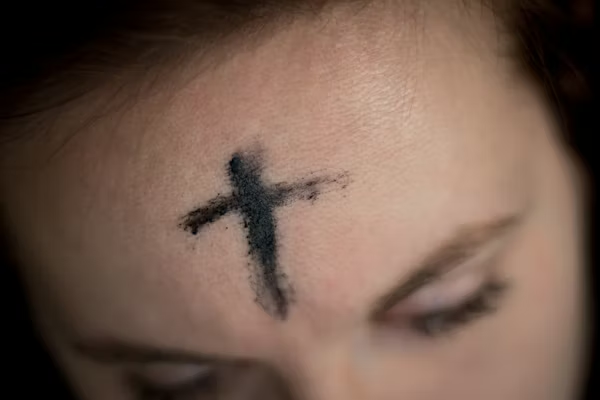 perhaps many who really have good intentions in their observance. But in an article by the United States Conference of Catholic Bishops, they state, “Accordingly, while appealing for greater development of the understanding of the Lenten liturgy … we hope that the observance of Lent as the principal season of penance in the Christian year will be intensified.”4
“While being penitent – expressing sorrow over your sin – is good, penance has no place in the life of a follower of Christ. Penance is the process of suffering for your own sins, and ignores the fact that Jesus suffered in our place. Along with the doctrine of Purgatory, it denies the sufficiency of Jesus’ substitutionary death on the cross. Expressing sorrow over sin is good, but self-abasement for sins as an act of penance does indeed obscure the gospel.”5
I’m thankful and humbled that Jesus suffered for me! Let that be what prepares you for the Easter season. 1 Peter 3:18 reminds us, “For Christ also hath once suffered for sins, the just for the unjust, that he might bring us to God, being put to death in the flesh, but quickened by the Spirit.”
1https://www.nationaldaycalendar.com/national-day/paczki-day-day-before-ash-Wednesday
2https://ewtn.co.uk/article-beyond-beads-and-parades-the-catholic-spirit-of-mardi-gras/
3https://www.kplctv.com/2022/02/19/ritual-disrobement-sociology-behind-mardi-gras-tradition/
4https://www.usccb.org/prayer-and-worship/liturgical-year-and-calendar/lent/us-bishops-pastoral-statement-on-penance-and-abstinence
5https://godwords.org/whats-wrong-with-lent/
Images are taken from https://pixabay.com/, https://www.pexels.com/, or https://unsplash.com/images or created in Windows Copilot. According to the websites, they are Royalty Free and free to be used for our purposes.
