

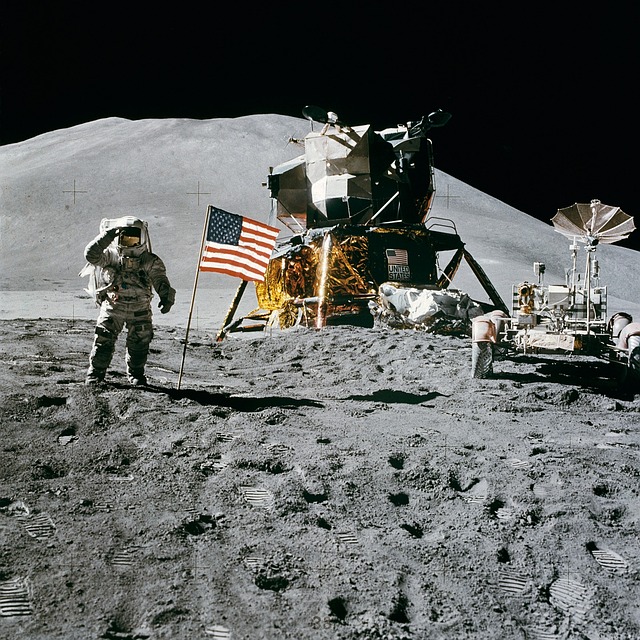
 Did you know that life has been discovered on the moon? According to astronomer Dr. Andrew Grant, the moon has “unicorns, two-legged beavers and furry, winged humanoids resembling bats.” He has also discovered that “the moon’s geography, [is] complete with massive craters, enormous amethyst crystals, rushing rivers and lush vegetation.”1 Can you believe it?
Well, the people reading the New York Sun on August 25, 1835 believed it!
A series of six articles were written by Richard Adams Locke and the byline was credited to a Dr. Andrew Grant, a colleague of “Sir John Herschel, a famous astronomer of the day. Herschel had in fact traveled to Capetown, South Africa, in January 1834 to set up an observatory with a powerful new telescope.”2 These articles were reprinted from the Edinburgh Journal of Science. And people scarfed up the news like a hungry dog on a bowl of Kibble!
One problem: none of it was true. Edinburgh had stopped publishing their magazine years earlier and Dr. Andrew Grant was a fictitious character. “Readers were completely taken in by the story, however, and failed to recognize it as satire. The craze over Herschel’s supposed discoveries even fooled a committee of Yale University scientists, who traveled to New York in search of the Edinburgh Journal articles. After Sun employees sent them back and forth between the printing and editorial offices, hoping to discourage them, the scientists returned to New Haven without realizing they had been tricked.”3
On September 16, 1835, the newspaper admitted the hoax to the amusement of most of the readers.
This harmless journalistic prank highlights the gullibility of people. Today, people are just as gullible. They read it and run with it. After all, we know that everything you read on the Internet is factual, right? Snopes.com compiled some of the biggest hoaxes offered up in 2023. Many were from Facebook, like:
- Cracker Barrel Old Country Store and Wendy’s Closing All Locations
- Disney World is moving to Georgia
- Facebook is set to charge $4.99 per month
- Facebook can get your friends back and get rid of ads4
Why do we believe things so quickly? “The brain is set up to give us easy answers … so if there’s a hoax that appeals to people’s emotions or intuition, it’s going to trick people, because a lot of people just don’t spend that much time thinking about the things that they see on social media,” says Gordon Pennycook, an assistant professor of behavioral science at the University of Regina in Canada who studies decision making. “Social media is partly to blame, too, because it’s set up to drive engagement, and that engagement often comes at the cost of shutting off people’s brains a little bit.”5
We get duped because we don’t spend that much time thinking! That has to be one of the saddest things you could read about humanity. People hear something and believe it without investigating, challenging, or thinking. While these deceitful stories may not be life or death, there are plenty of false teachers out there spinning spiritual stories that are loaded with lies and deceit. The effects of this are far greater.
2 Peter 2:1-3 warns, “But there were false prophets also among the people, even as there shall be false teachers among you, who privily shall bring in damnable heresies, even denying the Lord that bought them, and bring upon themselves swift destruction. (2) And many shall follow their pernicious ways; by reason of whom the way of truth shall be evil spoken of. (3) And through covetousness shall they with feigned words make merchandise of you: whose judgment now of a long time lingereth not, and their damnation slumbereth not.”
The antidote for these deceivers is found in Acts 17:10-11. “And the brethren immediately sent away Paul and Silas by night unto Berea: who coming thither went into the synagogue of the Jews. (11) These were more noble than those in Thessalonica, in that they received the word with all readiness of mind, and searched the scriptures daily, whether those things were so.”
Paul, an Apostle of God, was the teacher and they didn’t even just take his word as gospel. They compared Scripture with Scripture to make sure his message was spot on. He wasn’t offended by this. Instead, he penned praise for their due diligence.
We must run everything we read and hear through a skeptical filter. For our own sakes, let me close with a warning from 1 John 4:1. “Beloved, believe not every spirit, but try the spirits whether they are of God: because many false prophets are gone out into the world.”
1https://www.history.com/this-day-in-history/the-great-moon-hoax
2Ibid.
3Ibid.
4https://www.snopes.com/collections/top-10-snopes-stories-2023/
5https://www.wired.com/story/why-people-keep-falling-viral-hoaxes/
Images are taken from https://pixabay.com/, https://www.pexels.com/, or https://unsplash.com/images or created in Windows Copilot. According to the websites, they are Royalty Free and free to be used for our purposes.
