

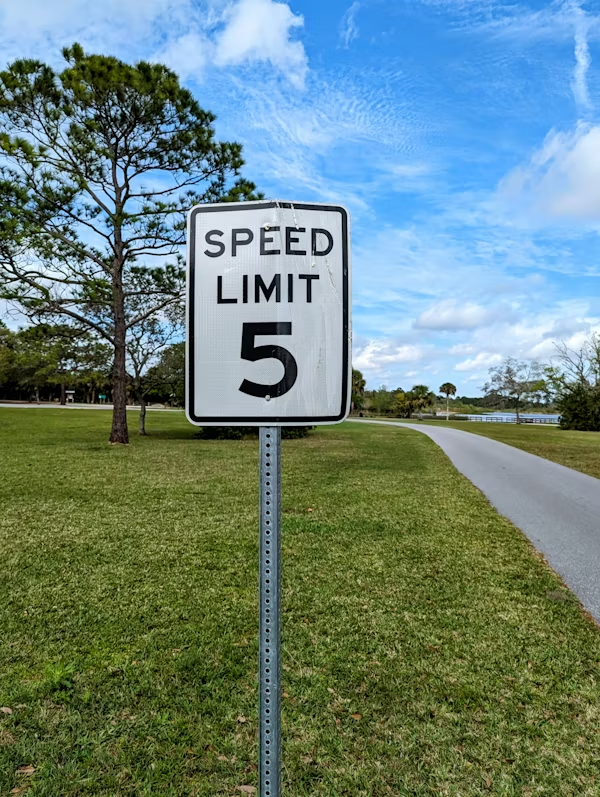
 It’s all Connecticut’s fault!
On this day in 1901, Connecticut brought us all to a screeching halt – almost. They were the first state to pass legislation establishing speed limits for motorized vehicles. Remember that the gasoline powered vehicle was in its infancy. The 1901 Oldsmobile Curved Dash could reach a blistering speed of 25 mph. The Lohner-Porsche Phaeton topped out at 22 mph. However, the Mercedes 35HP Phaeton could reach speeds of 43-47 mph while the racing version could exceed 53 mph.
Connecticut’s laws brought the city speed limit down to 12 mph and country roads were governed at 15 mph.
“Speed limits had been set earlier in the United States for non-motorized vehicles: In 1652, the colony of New Amsterdam (now New York) issued a decree stating that “[N]o wagons, carts or sleighs shall be run, rode or driven at a gallop” at the risk of incurring a fine starting at “two pounds Flemish,” or about $150 in today’s currency. In 1899, the New York City cabdriver Jacob German was arrested for driving his electric taxi at 12 mph.
“The path to Connecticut’s 1901 speed limit legislation began when Representative Robert Woodruff submitted a bill to the State General Assembly proposing a motor-vehicles speed limit of 8 mph within city limits and 12 mph outside. The law passed in May 1901 specified higher speed limits but required drivers to slow down upon approaching or passing horse-drawn vehicles, and come to a complete stop if necessary to avoid scaring the animals.”1
As vehicles advanced and more horsepower became available under the hood, laws were adjusted accordingly. Some, though, may remember the early 1970s when there was the nation’s oil embargo from OAPEC. Because prices skyrocketed from about 35 cents per gallon to 53 cents per gallon (41% increase), President Nixon signed a law making the maximum speed limit nationwide to be 55 mph. It was not until April 2, 1987 that this law was repealed and states were allowed to set the maximum speed at 65 mph. In 1995, states were permitted to set their own speed limits.
Can you imagine a 15-mph speed limit?!? Sure, we still have that in an alley. But would you want to travel 15 mph on SR 34 or SR 6? Back then, they probably felt like they were flying – maybe! If they were on a good horse, it could easily run 25-30 mph, and an elite racing breed could run over 40 mph.
Let’s face it. We don’t like limits. We don’t like them on the road. We don’t like that line that limits us by saying “10 items or less” when we have 11 items. We don’t like the sign at the bank drive thru that says, “Limit 3 transactions.” We don’t like the sale that says, “Limit two per customer.” We didn’t like time limits in school when we were taking tests. We don’t like our time to be limited in other places.
Limits force discipline, something that makes us chafe around the collar. The imposed restriction gnaws at our independent, rebellious, selfish nature that wants to do what it wants to do. Being a Christian doesn’t make the desire go away. We also must limit ourselves.
Twice, Paul makes an interesting statement. 1 Corinthians 6:12 says, “All things are lawful unto me, but all things are not expedient: all things are lawful for me, but I will not be brought under the power of any.” And 1 Corinthians 10:23 says, “All things are lawful for me, but all things are not expedient: all things are lawful for me, but all things edify not.”
Let’s understand what Paul is saying. First, he is not saying that believers can do anything they want (all things are lawful). Sin is never lawful. The context bears out that Paul is talking about eating meat offered to idols, something that was not sinful but some perceived it to be. Paul was saying that he has liberty concerning such matters. That liberty, though, is governed by several things.
- All things are not expedient. The word expedient simply means beneficial or profitable. Paul doesn’t want to waste time on things that will not bring about good in his life or the lives of others.
- All things do not edify; they don’t build up. If something isn’t constructive, then it is destructive. Paul only wants things in his life that will help grow him into the kind of Christian he should be.
- Things that are not lawful, expedient, and edifying can have the power of bondage on our lives. Since grace and salvation has made him a free man, Paul doesn’t want
 anything to control him that isn’t good and Godly.
Discipline that governs and limits our behavior is a good thing. We need that to keep us in check. Do you have that today? Have you set some limits on your life? If not, ask the Lord to show you where some limits might be in order.
“Know ye not that they which run in a race run all, but one receiveth the prize? So run, that ye may obtain. (25) And every man that striveth for the mastery is temperate in all things. Now they do it to obtain a corruptible crown; but we an incorruptible. (26) I therefore so run, not as uncertainly; so fight I, not as one that beateth the air: (27) But I keep under my body, and bring it into subjection: lest that by any means, when I have preached to others, I myself should be a castaway.” (1 Corinthians 9:24-27)
1https://www.history.com/this-day-in-history/may-21/connecticut-enacts-first-speed-limit-law
Images are taken from https://pixabay.com/, https://www.pexels.com/, or https://unsplash.com/images or created in Windows Copilot. According to the websites, they are Royalty Free and free to be used for our purposes.
