
 Today has been designated as the National Day of Prayer (NDP). This history of this day dates back many years and, honestly, it confuses me just a bit.
“On April 17, 1952, a bill initiated by Mr. Conrad Hilton of Hilton Hotels and Senator Frank Carlson of Kansas was passed (Public Law 82-324, Sec. 119) that:
“The President shall set aside and proclaim a suitable day each year, other than a Sunday, as a National Day of Prayer, on which the people of the United States may turn to God in prayer and meditation at churches, in groups, and as individuals.”1 It only took 31 years for the first NDP event to happen.
If this was passed into law, my understanding is that it is law until someone votes or legislation is passed removing it from law. However, in 1986, “Vonette Bright [co-founder of Campus Crusade for Christ] and the National Prayer Committee contacted Senator Strom Thurmond (R) for guidance on writing a bill that would designate a day for the National Day of Prayer. [The next year,] Senator Thurmond wrote the bill then introduced it to the Senate Judiciary Committee. It became bill S.1378, which would amend public law 82-324. While Senator Thurmond works the bill through the Senate, Congressman Tony Hall champions the bill through the House of Representatives, often fielding calls from Vonette Bright on the status of the bill moving through committee…
“On May 5, 1988, President Ronald Reagan signs into law Public Law 100-307, designating the first Thursday in May as the annual observance for the National Day of Prayer. [The law reads] The President shall set aside and proclaim the First Thursday in May in each year, as a National Day of Prayer, on which the people of the United States may turn to God in prayer and meditation at churches, in groups, and as individuals.”
“Then, on August 12, 1988, President Bill Clinton signs into law – Pub. L. 105-225., August 12, 1998, 112 Stat. 1258, The President shall issue each year a proclamation designating the first Thursday in May as a National Day of Prayer on which the people of the United States may turn to God in prayer and meditation at churches, in groups, and as individuals.”1
If you know why a law has to be reissued as another law, even though the wording is essentially the same, you’re doing better than me!
The point of a National Day of Prayer hearkens back to the early days of our nation. “On March 16, 1776, the Continental Congress passed without dissent a resolution presented by General William Livingston declaring: “Congress….desirous…to have people of all ranks and degrees duly impressed with a solemn sense of God’s superintending providence, and of their duty, devoutly to rely…on his aid and direction…do earnestly recommend Friday, the 17th day of May be observed by the colonies as a Day of Humiliation, Fasting and Prayer; that we may, with united hearts, confess and bewail our manifold sins and transgressions, and, by sincere repentance and amendment of life, appease God’s righteous displeasure, and, through the merits and mediation of Jesus Christ, obtain this pardon and forgiveness.”
“On May 15, 1776, General George Washington ordered: “The Continental Congress having ordered Friday the 17th instant to be observed as a Day of Fasting, Humiliation and Prayer, humbly to supplicate the mercy of Almighty God, that it would please Him to pardon all our manifold sins and transgressions, and to prosper the arms of the United Colonies, and finally establish the peace and freedom of America upon a solid and lasting foundation; the General commands all officers and soldiers to pay strict obedience to the orders of the Continental Congress; that, by their unfeigned and pious observance of their religious duties, they may incline the Lord and Giver of victory to prosper our arms.”2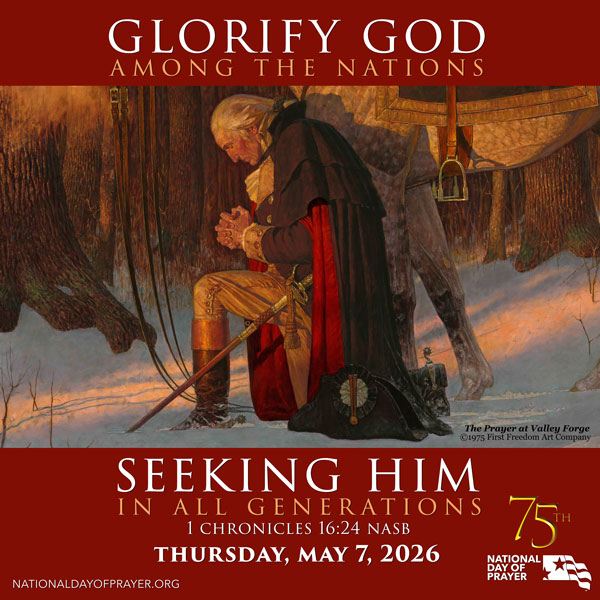
This wouldn’t be the last time Washington called our nation to prayer. “The same week Congress passed the Bill of Rights, President George Washington declared, October 3, 1789: “It is the duty of all nations to acknowledge the Providence of Almighty God, to obey His will…and humbly to implore His protection and favor; and Whereas both Houses of Congress have by their joint Committee requested me ‘to recommend to the People of the United States a Day of Public Thanksgiving and Prayer to be observed by acknowledging with grateful hearts the many signal favors of Almighty God, especially by affording them an opportunity peaceably to establish a form of government for their safety and happiness’…”
“I do recommend…the 26th day of November next, to be devoted by the People of these United States to the service of that great and glorious Being, who is the beneficent Author of all the good that was, that is, or that will be; That we may then all unite in rendering unto Him our sincere and humble thanks…for the peaceable and rational manner in which we have been enabled to establish constitutions of government for our safety and happiness, and particularly the national one now lately instituted, for the civil and religious liberty with which we are blessed… Humbly offering our prayers…to the great Lord and Ruler of Nations, and beseech Him to pardon our national and other transgressions.”3
The theme of this year’s NDP promotional is Glorifying God Among The Nations, Seeking Him In All Generations. The ad features a picture of Washington kneeling in the snow in prayer at Valley Forge. The theme verse is 1 Chronicles 16:24. “Declare his glory among the heathen; his marvellous works among all nations.”
While I greatly appreciate the call for a nation to get on their faces before God, I also know that the hope of our nation is in the Christians getting on their faces before God. 2 Chronicles 7:14 says, “If my people, which are called by my name, shall humble  themselves, and pray, and seek my face, and turn from their wicked ways; then will I hear from heaven, and will forgive their sin, and will heal their land.”
Renewal in our land begins with renewal among the Christians in the church and not just those who call themselves Christian. This is for those who are genuinely born again children of Almighty God.”
May the emphasis of today remind us that we need to cry out to God in humble desperation for the sake of our nation. Will we do that, not only today, but every day? James 5:16 reminds us that “The effectual fervent prayer of a righteous man availeth much.”
1https://www.nationaldayofprayer.org/about/history
2https://www.nationaldayofprayer.org/about/history_of_prayer_in_america
3Ibid.
Images are taken from https://pixabay.com/, https://www.pexels.com/, or https://unsplash.com/images or created in Windows Copilot. According to the websites, they are Royalty Free and free to be used for our purposes.
