

 In 1915, the United States Industrial Alcohol Company (USIA) built a storage tank in Boston to hold imported molasses from which the alcohol would be developed. The tank towered 58-feet into the air and was 90-feet in diameter. Industrial alcohol is essentially denatured alcohol or ethanol and it is unfit for human consumption. With WWI in progress, the alcohol was used in munitions needed by the military.
On November 11, 1918, WWI comes to an end but on this day in 1919, tragedy comes to Boston. At approximately 12:30 p.m., “the bolts holding the bottom of the tank exploded, shooting out like bullets.”1 “Witnesses reported that they felt the ground shake and heard a roar as it collapsed, a long rumble similar to the passing of an elevated train; others reported a tremendous crashing, a deep growling, “a thunderclap-like bang!“, and a sound like a machine gun as the rivets shot out of the tank.”2
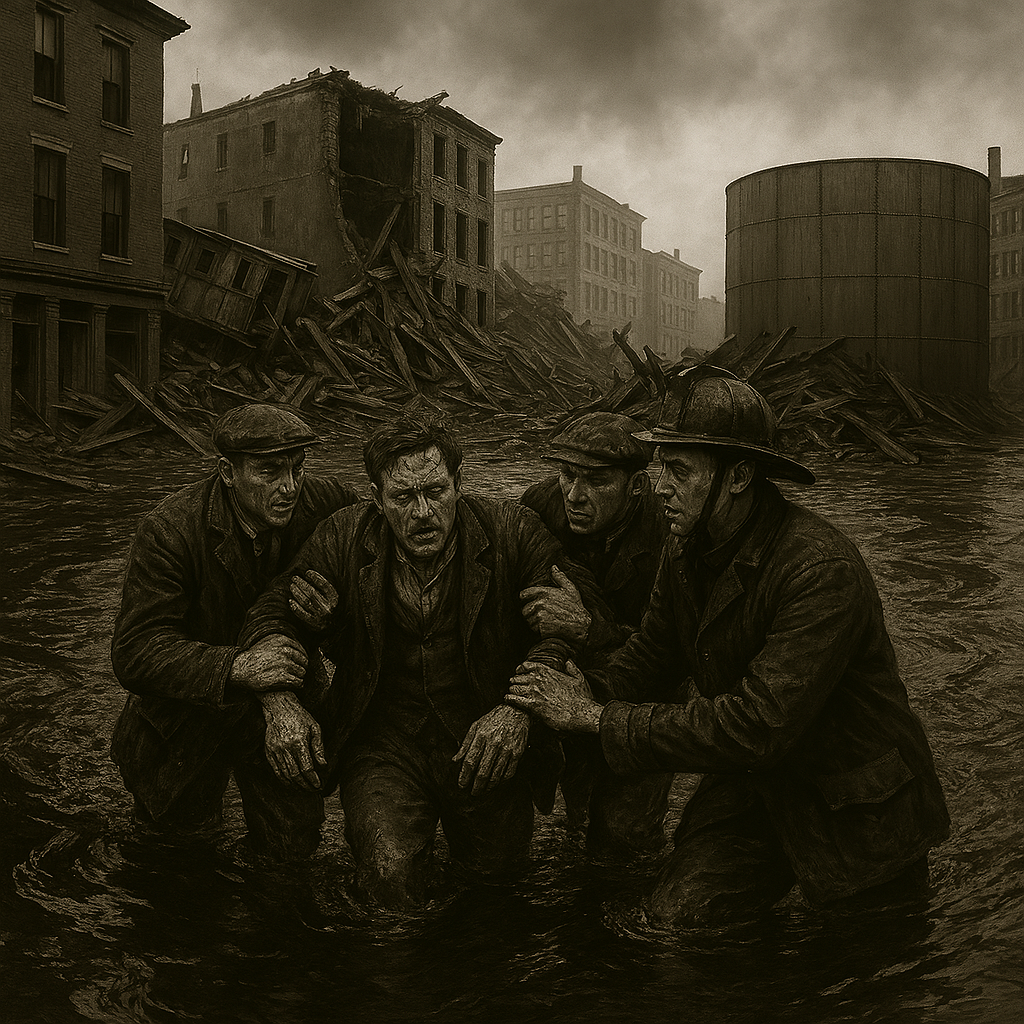
Fiery hot molasses floods the streets of Boston.3 “The density of molasses is about 1.4 metric tons per cubic meter (12 pounds per US gallon), 40 percent more dense than water, resulting in the molasses having a great deal of potential energy. The collapse translated this energy into a wave of molasses 25 ft (8 m) high at its peak, moving at 35 mph (56 km/h). The wave was of sufficient force to drive steel panels of the burst tank against the girders of the adjacent Boston Elevated Railway’s Atlantic Avenue structure and tip a streetcar momentarily off the El’s tracks. Stephen Puleo describes how nearby buildings were swept off their foundations and crushed.”4
In all, 21 people died, more than 150 were injured, and dozens of horses were killed.5 It took weeks to clean up the mess and decades for the smell of molasses to disappear.
How could such a tragedy have happened? Over 100 lawsuits were filed against USIA. Six years of investigation, 3,000 witnesses, and 45,000 pages of testimony resulted in over $1 million awarded from USIA as they were found at fault. Through the years, investigations have continued even into recent years. The findings can be summarized as follows:
- The steel used to construct the tank was too thin for the weight of the molasses.
- Flawed rivet designs.
- Failure to test the structure with water before adding hot molasses.

- Cracks in the structure were ignored even though raw molasses oozed from those cracks.
- Atmospheric temperature fluctuation.
- Lack of responsible actions of those in charge.
Disaster is bound to happen when there is negligence. The same is true in our personal lives. Notice what the Psalmist admits in Psalms 119:176. “I have gone astray like a lost sheep; seek thy servant; for I do not forget thy commandments.” After 175 verses which extol wonderful, Biblical truths, the Psalmist admits that he has still gone astray. How is that possible?
Too often, Christians will live their lives with an adherence to rules rather than relationship. Like the Pharisees, they will follow the letter of the law, invent laws when the law seems inadequate in specifications, and believe that this is fostering a growing relationship with the Lord. The Christian living under rules will say, “Thus saith the Word!” when the Word really doesn’t say it.
James 4:6-8 gives a three-fold way to keep spiritual neglect at bay and shows us how to stimulate growth in our relationship with the Lord. The passage starts out with this: “But he giveth more grace. Wherefore he saith, God resisteth the proud, but giveth grace unto the humble.” We need to humble ourselves before our God. That means we stop acting like we know it all and crave holy, Biblical correction.
Secondly, verse 7 says, “Submit yourselves therefore to God. Resist the devil, and he will flee from you.” “Submit” means that we willingly line up under God’s leadership. We place ourselves under Him and fight down that urge to rise to the top.
Third, verse 8 says, “Draw nigh to God, and he will draw nigh to you. Cleanse your hands, ye sinners; and purify your hearts, ye double minded.” Humbling ourselves, submitting, and draw nigh to God comes BEFORE we can accurately cleanse our hands and purify our hearts.
Christians, let’s not neglect our walk with the Lord and get ourselves in a sticky situation. Nurture that walk with the Lord every day. Eliphaz, one of Job’s judgmental counselors, gave good advice though it was misapplied. Let’s make accurate application of it in our lives.
“Receive, I pray thee, the law from his mouth, and lay up his words in thine heart. (23) If thou return to the Almighty, thou shalt be built up, thou shalt put away iniquity far from thy tabernacles.” (Job 22:22-23)
1https://www.history.com/this-day-in-history/january-15/molasses-floods-boston-streets
2https://en.wikipedia.org/wiki/Great_Molasses_Flood
3https://www.history.com/this-day-in-history/january-15/molasses-floods-boston-streets
4https://en.wikipedia.org/wiki/Great_Molasses_Flood
5https://www.history.com/articles/great-molasses-flood-science
Images are taken from https://pixabay.com/, https://www.pexels.com/, or https://unsplash.com/images or created in Windows Copilot. According to the websites, they are Royalty Free and free to be used for our purposes.
