

 Johann Gottfried Galle, Urbain Le Verrier, and John Couch Adams are names probably none of us recognize. If you do recognize those names, you are worthy of being a contestant on Jeopardy! These men made their mark on the world on September 23-24, 1846, the same year that the Liberty Bell cracks, the saxophone is patented, Abraham Lincoln is elected as U.S. Representative from the State of Illinois, the patent for the sewing machine is granted, and ether is used for an anesthetic for the first time.
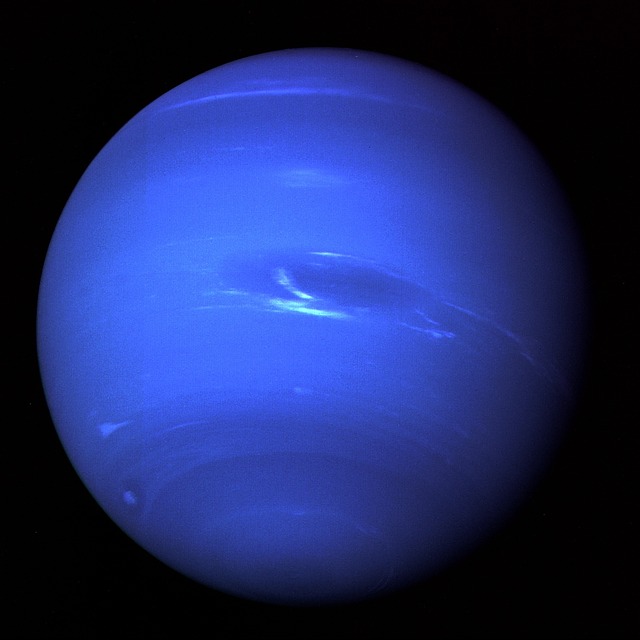
The aforementioned men discovered Neptune, the eight planet in our solar system.
“Astronomer Johann Gottfried Galle used the Fraunhofer telescope at the Berlin Observatory and made the first observations of the new planet, only 1 degree from its calculated position.”1 Neptune’s distance makes it impossible to see with the naked eye. The Fraunhofer telescope, though, certainly pales in comparison to some of the basic telescopes available for the general public to purchase.
“The blue gas giant, which has a diameter four times that of Earth, was named for the Roman god of the sea. It has 14 known moons, of which Triton is the largest, and a ring system containing three bright and two dim rings. It completes an orbit of the sun once every 165 years.”2 Voyager 2, a part of the Voyager interstellar mission, was launched on August 20, 1977. A mere 4389 days (12 years, 6 days) after the launch, Voyager 2 made a fly-by of Neptune, sending back to earth our first up close pictures.3
I’ve never been much of a stargazer myself. I do find it interesting, though, to go out and appreciate the magnitude of a beautiful, starlit evening. And for those who really enjoy the telescopic observances, I think that this must have been an amazing discovery.
What puzzles me is how people who get to see the intricate wonders of God could ever conclude that this all came to being through evolution or cosmic collision. I’m just as baffled when a surgeon opens the body and gets to see the inner workings of our anatomy and concludes that THEY are the ones who are such a great physician. That’s like a child drawing a picture of the sky with a crayon, holding that picture up against a picture of the Sistine Chapel, then concluding that they are an artist, too.
David was overwhelmed by the universe. Perhaps one night while watching the sheep,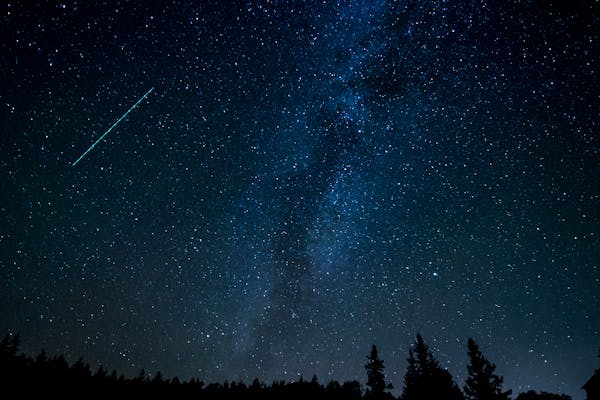 he was given the words to Psalms 19:1-6. “The heavens declare the glory of God; and the firmament sheweth his handywork. (2) Day unto day uttereth speech, and night unto night sheweth knowledge. (3) There is no speech nor language, where their voice is not heard. (4) Their line is gone out through all the earth, and their words to the end of the world. In them hath he set a tabernacle for the sun, (5) Which is as a bridegroom coming out of his chamber, and rejoiceth as a strong man to run a race. (6) His going forth is from the end of the heaven, and his circuit unto the ends of it: and there is nothing hid from the heat thereof.”
Looking into the vastness of the universe through a telescope or through the pictures sent back from Voyager 2, we should assess ourselves to be merely specks in the universe. Yet, while the planets cannot be seen by our naked eye, the God of the Universe sees everyone of us. And not just our outside. He knows the “thoughts and intents of the heart!” (Hebrews 4:12)
A look up into the starry night should cause us to say what the Psalmist said in Psalms 8:3-9. “When I consider thy heavens, the work of thy fingers, the moon and the stars, which thou hast ordained; (4) What is man, that thou art mindful of him? and the son of man, that thou visitest him? (5) For thou hast made him a little lower than the angels, and hast crowned him with glory and honour. (6) Thou madest him to have dominion over the works of thy hands; thou hast put all things under his feet: (7) All sheep and oxen, yea, and the beasts of the field; (8) The fowl of the air, and the fish of the sea, and whatsoever passeth through the paths of the seas. (9) O LORD our Lord, how excellent is thy name in all the earth!”
1https://www.nasa.gov/history/175-years-ago-astronomers-discover-neptune-the-eighth-planet
2https://www.history.com/this-day-in-history/eighth-planet-discovered
3https://www.nasa.gov/solar-system/30-years-ago-voyager-2s-historic-neptune-flyby/
Images are taken from https://pixabay.com/, https://www.pexels.com/, or https://unsplash.com/images or created in Windows Copilot. According to the websites, they are Royalty Free and free to be used for our purposes.
