

 I’m writing this devotional on December 11, 2025, so I don’t know what our weather is going to be on this first Saturday of a new year. But I think it is safe to say and I’m repeating what I’ve heard many people say – we’ve had enough snow for this winter! It has definitely been an unusual winter compared to winters of the past several years.
Since we’ve seen our fair share of snow and knowing that there is probably going to be more before the season ends, I want to share some interesting facts about snow.
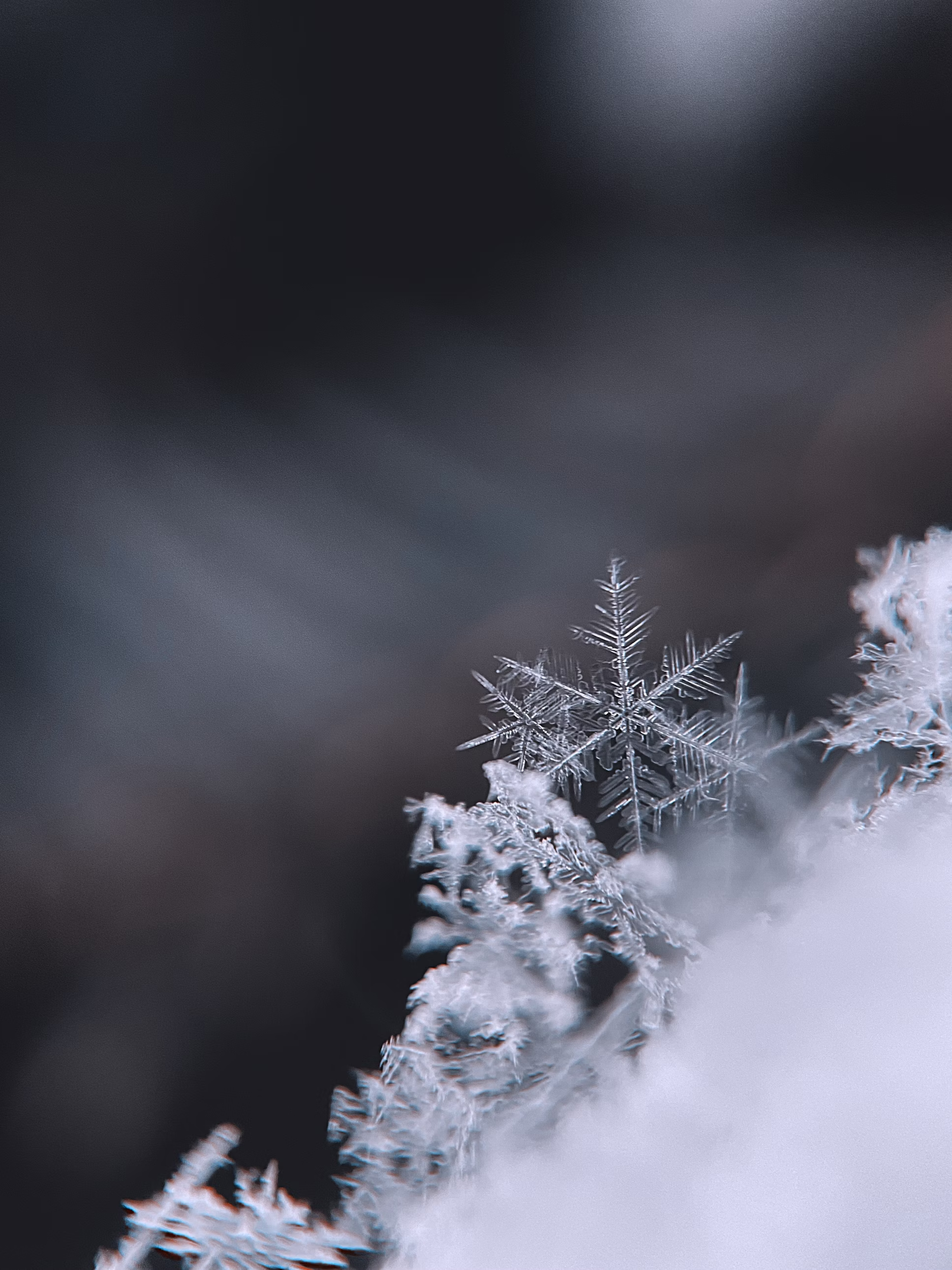
- If we were going to be accurate, we would have to sing I’m dreaming of a translucent Christmas because snow really isn’t white. “Snow is comprised of a bunch of individual ice crystals arranged together. When a light photon enters a layer of snow, it goes through an ice crystal on the top, which changes its direction slightly and sends it on to a new ice crystal, which does the same thing. Basically, the crystals bounce the light all around so that the light comes right back out of the snow pile. Snow does the same thing to all the different light frequencies, so all colors of light are bounced back out. The “color” of all the frequencies in the visible spectrum combined in equal measure is white, so this is the color we see in snow, even though white isn’t the color we “see” in the individual ice crystals that form snow.”1
- Snowflakes can be massive! The average “jumbo crystal” is 2-6 inches. In 1887, it was reported that flakes were 15 inches at Ft. Keogh, Montana! No photographic or documented evidence exists so this might be a tall tale from 138 years ago.2

- Wilson Bentley, a farmer from Vermont, is credited with taking the first picture of a snowflake in 1885. For four decades, he took pictures and recorded atmospheric conditions during the snowfall. He was quite proud of his photography and after donating 500 pictures to the Smithsonian, he said, “My collection [is] far superior in both number & beauty & I might add interest, to that of any other collection in the world…”3
- “The first reference to snow plows dates back to 1792. These early contraptions were horse-drawn wedge plows made of wood. Communities also utilized snow rollers, which are essentially large, weighted wheels pulled by oxen or horses to smooth out snow, rather than remove it, similar to flattening snow on a ski slope. The mid-1800s saw the introduction of horse-drawn snow plows designed for clearing alleys and streets with heavier foot traffic. In 1862, Milwaukee became the first city to adopt the use of snow plows, a much more convenient alternative to shoveling by hand.”4

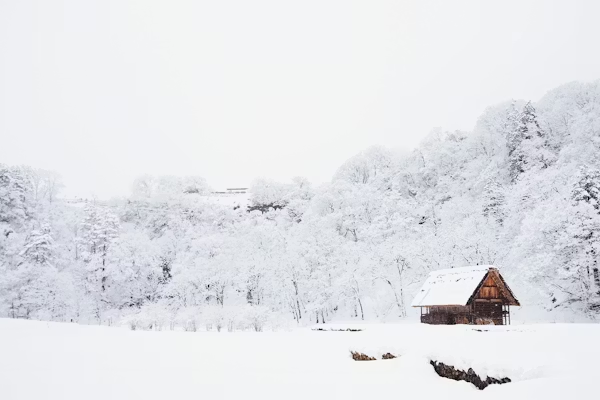 The most amazing fact about snow is that it is created and deposited by God. Elihu states in Job 37:6, “For he saith to the snow, Be thou on the earth; likewise to the small rain, and to the great rain of his strength.” Elihu isn’t the only one who acknowledges this.
Psalms 147:16-17 He giveth snow like wool: he scattereth the hoarfrost like ashes. (17) He casteth forth his ice like morsels: who can stand before his cold?
Psalms 148:7-8 Praise the LORD from the earth, ye dragons, and all deeps: (8) Fire, and hail; snow, and vapour; stormy wind fulfilling his word:
Okay, it’s time for a moment of confession. Every time we complain about snow – and I’m definitely guilty of that – we have complained about what God has given. The weather is merely “fulfilling His word.” Any other time, we would want God’s Word fulfilled but when the snow hits the ground and we start to shiver, the griping begins through our chattering teeth.
The next time the weather isn’t exactly what you would have ordered, stop and ask the Lord, “What’s the reason you’ve given this?” “He causeth it to come, whether for correction, or for his land, or for mercy.” (Job 37:13)
1https://science.howstuffworks.com/nature/climate-weather/atmospheric/question524.htm
2https://interestingfacts.com/snow-facts/?lctg=e6fd7449-4b4d-4d27-9340-7ad6e03075f2
3https://siarchives.si.edu/history/featured-topics/stories/wilson-bentley-pioneering-photographer-snowflakes
4https://minnesotaequipment.com/the-history-of-snow-removal-equipment/
Images are taken from https://pixabay.com/, https://www.pexels.com/, or https://unsplash.com/images or created in Windows Copilot. According to the websites, they are Royalty Free and free to be used for our purposes.
