
 He didn’t deserve it. He had committed a crime, brought shame on the nation and his family, and brought his office into disrepute. He deserved a trial, considering the scandal he caused. He deserved jail. Instead, he received a pardon.
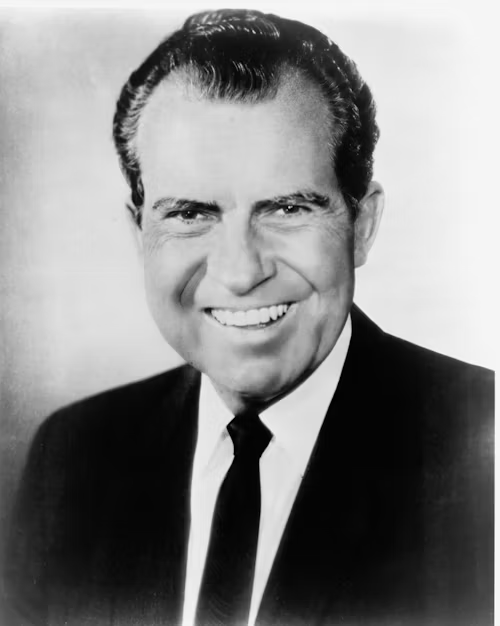
His name was Richard M. Nixon. The pardon was granted by President Gerald Ford on September 8, 1974, just 30 days after taking office. And on this day in 1974, Ford stood before Congress, giving an explanation as to why he pardoned rather than prosecuting.
Historical records tell the story about Watergate. “The Watergate scandal began early in the morning of June 17, 1972, when several burglars were arrested in the office of the Democratic National Committee, located in the Watergate complex of buildings in Washington, D.C. This was no ordinary robbery: The prowlers were connected to President Richard Nixon’s reelection campaign, and they had been caught wiretapping phones and stealing documents. Nixon took aggressive steps to cover up the crimes.”1
Most of us would say that prosecution should have happened. An example should be made of how corruption will be dealt with, even if it comes from the highest office in the land. Rather than being impeached, President Nixon resigned. A presidential pardon doesn’t seem fitting – and this is obviously how the nation thinks because President Ford lost his election campaign in 1976. The blame for the loss was placed squarely on this decision to pardon.
What was Ford’s reasoning? First, it’s important to note that Ford never exonerated Nixon. Ford never pretended or insinuated that nothing had been done wrong. On this day in 1974, the Judiciary Subcommittee of Congress questioned him as to why this pardon was granted. Ford replied, “The reason that I gave the pardon was not as to Mr. Nixon himself. I repeat and I repeat with emphasis. The purpose of the pardon was to try and get the United States, the Congress, the President, and the American people focusing on the serious problem that we have at home and abroad. I am absolutely convinced then as I am now that if we had had this series, an indictment, a trial, a conviction, and anything that transpired after that, that the attention of the President, the Congress, and the American people would have been diverted from the problems that we have to solve. And that was my principal reason for the granting of the pardon.”2
I know this will make the devotional longer, but I love historical documents. When President Ford addressed the nation upon pardoning Richard Nixon, he closed his message with these words.
“As President, my primary concern must always be the greatest good of all the people of the United States whose servant I am. As a man, my first consideration is to be true to my own convictions and my own conscience.
“My conscience tells me clearly and certainly that I cannot prolong the bad dreams that continue to reopen a chapter that is closed. My conscience tells me that only I, as President, have the constitutional power to firmly shut and seal this book. My conscience tells me it is my duty, not merely to proclaim domestic tranquility but to use every means that I have to insure it.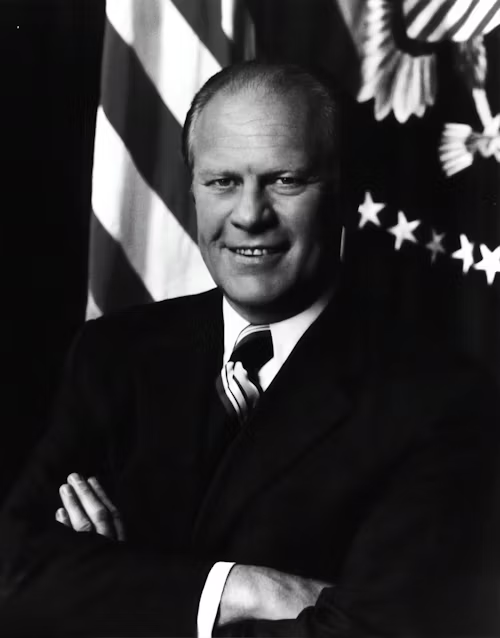
“I do believe that the buck stops here, that I cannot rely upon public opinion polls to tell me what is right.
“I do believe that right makes might and that if I am wrong, 10 angels swearing I was right would make no difference.
“I do believe, with all my heart and mind and spirit, that I, not as President but as a humble servant of God, will receive justice without mercy if I fail to show mercy.
“Finally, I feel that Richard Nixon and his loved ones have suffered enough and will continue to suffer, no matter what I do, no matter what we, as a great and good nation, can do together to make his goal of peace come true.
“Now, therefore, I, Gerald R. Ford, President of the United States, pursuant to the pardon power conferred upon me by Article II, Section 2, of the Constitution, have granted and by these presents do grant a full, free, and absolute pardon unto Richard Nixon for all offenses against the United States which he, Richard Nixon, has committed or may have committed or taken part in during the period from July (January) 20, 1969 through August 9, 1974.”
“In witness whereof, I have hereunto set my hand this eighth day of September, in the year of our Lord nineteen hundred and seventy-four, and of the Independence of the United States of America the one hundred and ninety ninth.”3
The official Proclamation 4311 stated that part of the reason for the pardon was, “It is believed that a trial of Richard Nixon, if it became necessary, could not fairly begin until a year or more has elapsed. In the meantime, the tranquility to which this nation has been restored by the events of recent weeks could be irreparably lost by the prospects of bringing to trial a former President of the United States. The prospects of such trial will cause prolonged and divisive debate over the propriety of exposing to further punishment and degradation a man who has already paid the unprecedented penalty of relinquishing the highest elective office of the United States.”4
We can argue all day long that the pardon wasn’t deserved, and you will get no complaint from me. But isn’t that the very nature of a pardon?
The prophet Micah declared in Micah 7:18, “Who is a God like unto thee, that pardoneth iniquity, and passeth by the transgression of the remnant of his heritage? he retaineth not his anger for ever, because he delighteth in mercy.” The great hymn writer, Thomas Chisolm, declared in song,
Pardon for sin and a peace that endureth,
Thine own dear presence to cheer and to guide,
Strength for today and bright hope for tomorrow,
Great is Thy faithfulness, Lord unto me!
The pardon we received from the Lord did NOT declare that we didn’t do anything wrong. We were just granted “a full, free, and absolute pardon.” The charges and consequences could no longer be brought up against us.
Sure, Nixon was guilty but so am I. So are you. Our cry is no different than the Psalmist’s and we are grateful for the Lord’s merciful response. “For thy name’s sake, O LORD, pardon mine iniquity; for it is great.” (Psalms 25:11)
1https://www.history.com/topics/1970s/watergate
2https://www.youtube.com/watch?v=XjQN3SfLnSI&embeds_referring_euri=https%3A%2F%2Fwww.bing.com%2F&embeds_referring_origin=https%3A%2F%2Fwww.bing.com&source_ve_path=Mjg2NjY
3https://millercenter.org/the-presidency/presidential-speeches/september-8-1974-remarks-pardoning-richard-nixon
4https://www.presidency.ucsb.edu/documents/proclamation-4311-granting-pardon-richard-nixon
Images are taken from https://pixabay.com/, https://www.pexels.com/, or https://unsplash.com/images or created in Windows Copilot. According to the websites, they are Royalty Free and free to be used for our purposes.
