
 One historical event tanked an individual’s political career. They made a decision, an act of grace and mercy that many did not agree with nor understand. Knowing full well that this could be the result, the individual moved forward, willing to fall on his own sword for the greater good.
Here is an abbreviated timeline of events.
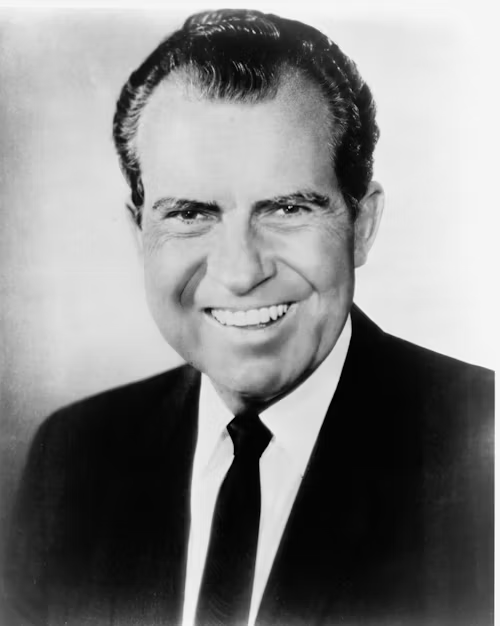
- November 5, 1968: Richard Nixon is elected President and inaugurated on January 20, 1969.
- July 1, 1971: David Young and Egil “Bud” Krogh write a memo suggesting the formation of what later became the “White House Plumbers” in response to the leak of the Pentagon Papersby Daniel Ellsberg.
- By early 1972, the Plumbers, at this stage assigned to the Committee to Re-Elect the President (abbreviated CRP), had become frustrated at the lack of additional assignments they were being asked to perform, and that any plans and proposals they suggested were being rejected by CRP.
- May 28, 1972: Liddy’s team breaks into DNC Headquarters at the Watergate complex for the first time, bugging the telephones of staffers.
- June 17, 1972: The plumbers are arrested at 2:30 a.m. in the process of burgling and planting surveillance bugs in the DNC offices at the Watergate Building Complex.
- September 15, 1972: Hunt, Liddy, and the Watergate burglars are indicted by a federal grand jury.
- November 7, 1972: Nixon re-elected and inaugurated on January 20, 1973.
- March 17, 1973: Watergate burglar McCord writes a letter to Judge John Sirica, claiming that some of his testimony was perjured under pressure and that the burglary was not a CIA operation, but had involved other government officials, thereby leading the investigation to the White House.
- July 24, 1974:United States v. Nixon decided: in a unanimous decision, the Supreme Court orders Nixon to release his Oval Office tapes to investigators.
- Congress moves to impeach Nixon.
- July 27 to July 30, 1974: House Judiciary Committee passes Articles of Impeachment.
- Early August 1974: A previously unknown tape from June 23, 1972 (recorded a few days after the break-in) documenting Nixon and Haldeman formulating a plan to block investigations is released.
- August 7, 1974: Key congressional Republicans Sen. Barry Goldwater, House Republican Leader John Jacob Rhodes and Senate Republican Leader Hugh Scott tell Nixon that there are enough votes to impeach him in the House and convict him in the Senate. That evening, Nixon finalizes decision to resign.
- August 8, 1974: Nixon delivers his resignation speech before a nationally televised audience.
- August 9, 1974: Nixon resigns from office and Ford becomes president.1
- September 8, 1974: Newly sworn in President Gerald Ford announces to America that he is granting a presidential pardon to former President Richard M. Nixon.
In an extremely passionate, heartfelt speech, Ford told the nation, “I dare not depend upon my personal sympathy as a long-time friend of the former President, nor my professional judgment as a lawyer, and I do not.
“As President, my primary concern must always be the greatest good of all the people of the United States whose servant I am. As a man, my first consideration is to be true to my own convictions and my own conscience.
“My conscience tells me clearly and certainly that I cannot prolong the bad dreams that continue to reopen a chapter that is closed. My conscience tells me that only I, as President, have the constitutional power to firmly shut and seal this book. My conscience tells me it is my duty, not merely to proclaim domestic tranquility but to use every means that I have to insure it…
“Now, therefore, I, Gerald R. Ford, President of the United States, pursuant to the pardon power conferred upon me by Article II, Section 2, of the Constitution, have granted and by these presents do grant a full, free, and absolute pardon unto Richard Nixon for all offenses against the United States which he, Richard Nixon, has committed or may have committed or taken part in during the period from July (January) 20, 1969 through August 9, 1974.”2
Historians believe that this gesture of President Ford on behalf of former-President Richard Nixon cost him the election in 1976. Ford had to have known that this would ruin him. But, feeling that it was the right thing to do to bring healing to our nation, Ford did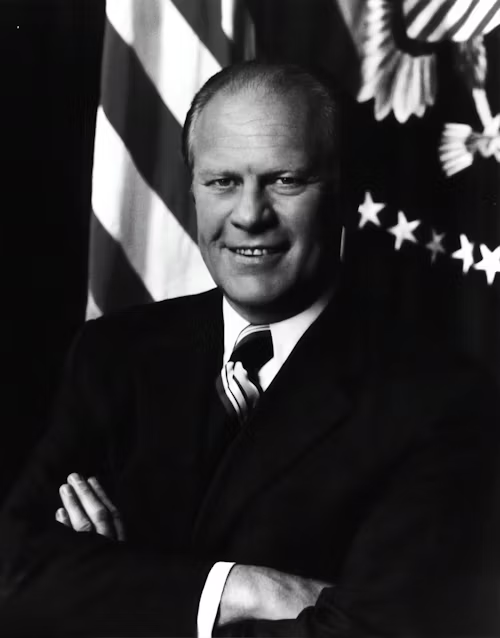 what he believed was necessary.
The purpose of the devotional is not to debate the legitimacy of the pardon. It is to remind us as believers that WE received grace, mercy, and pardon. And we didn’t deserve it.
Nehemiah 9:17 says, “… but thou art a God ready to pardon, gracious and merciful, slow to anger, and of great kindness, and forsookest them not.” The hymnwriter said,
Mercy there was great and grace was free,
Pardon there was multiplied to me,
There my burdened soul found liberty–
At Calvary.
I close today with a couple of verses in Psalms that ought to take our breath away and humble us before God. Psalms 130:3-4 says, “If thou, LORD, shouldest mark iniquities, O Lord, who shall stand? (4) But there is forgiveness with thee, that thou mayest be feared.”
1https://en.wikipedia.org/wiki/Timeline_of_the_Watergate_scandal
2https://www.presidency.ucsb.edu/documents/remarks-signing-proclamation-granting-pardon-richard-nixon
Images are taken from https://pixabay.com/, https://www.pexels.com/, or https://unsplash.com/images or created in Windows Copilot. According to the websites, they are Royalty Free and free to be used for our purposes.
