

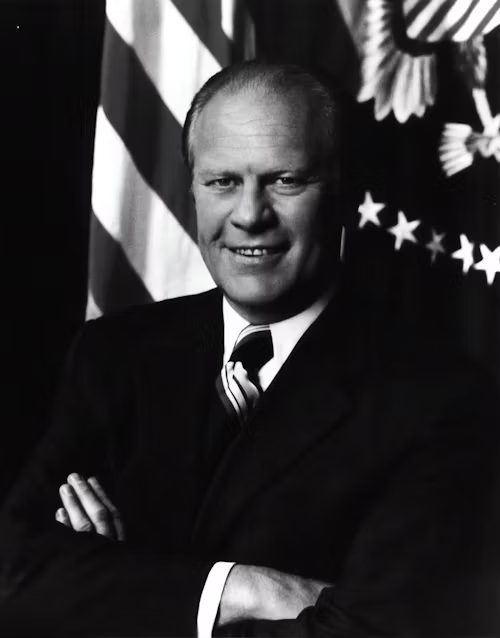
 Gerald R. Ford was the 38th President of the United States. He holds the unique distinction of the being the only person to have never been elected to the office of President or Vice-President. President Nixon appointed him as Vice-President when Spiro Agnew resigned. Ford took office in December 1973. Then, upon Nixon’s resignation in 1974, Ford became President according to the rules of succession laid out in the Constitution.
For those of us alive at the time or for historians, most people are stumped to remember much about the 38th President. Lawyer and Judge, Martha Griffiths, said of him, “In all the years I sat in the House, I never knew Mr. Ford to make a dishonest statement nor a statement part-true and part-false. He never attempted to shade a statement, and I never heard him utter an unkind word.”1
Though an athletic man who served in the United States Navy from 1942-1946, honorably discharged as a Lieutenant Commander, he was prone to clumsiness. His falls and trips became fodder for late night comedians. This also helped to earn him the reputation of being likable, simple, and an every man’s man.
Trying to think about what he accomplished in his 896 days in office – just two years, five months, and twelve days – leaves us scratching our heads. He pardoned President Nixon, an act believed to have torpedoed his campaign to get elected. He “issued Presidential Proclamation 4313, which introduced a conditional amnesty program for military deserters and Vietnam War draft dodgers who had fled to countries such as Canada. The conditions of the amnesty required that those reaffirm their allegiance to the United States and serve two years working in a public service job or a total of two years service for those who had served less than two years of honorable service in the military.”2
Beyond that, though, it’s hard to put a finger on any substantial policy issues or acts he accomplished. Reading through his biography, though, shows a man that was incredibly active in numerous organizations and pursuits post-presidency.
Unfortunately, one thing that is remembered about Ford is that during his short time in office, there were TWO attempts on his life. On September 5, 1975, Lynette “Squeaky” Fromme attempted to shoot the president. Seventeen days later on this day in 1975, Sara Jane Moore tried to shoot the president while he was leaving a hotel in San Francisco. Oliver Sipple, a bystander, saw her raise the gun and instinctively grabbed her arm, causing the shot to stray errantly. The secret service stepped in immediately, taking the president to safety.
Why would anyone want to kill Ford? What had he done that was so grievous that assassination attempts would be made on his life? Disagreeing with the person is one thing. Trying to kill a president? That’s just wrong. Worse, it is sin and an attitude of the heart that a believer must guard against.
Romans 13:1-2 says, “Let every soul be subject unto the higher powers. For there is no power but of God: the powers that be are ordained of God. (2) Whosoever therefore resisteth the power, resisteth the ordinance of God: and they that resist shall receive to themselves damnation.”
Immediately, we say, “Well, what are we supposed to do when those powers are trying to do wicked things?” We resist the wicked policies, not the people. We disagree respectfully. We try to make changes through the channels afforded. Clement of Alexandria said it very succinctly. “Above all, Christians are not allowed to correct with violence the delinquencies of sins…”
Titus 3:1-2 says, “Put them in mind to be subject to principalities and powers, to obey magistrates, to be ready to every good work, (2) To speak evil of no man, to be no brawlers, but gentle, shewing all meekness unto all men.”
Some of you might struggle with what I’m about to say. But, if Jesus is to be our example and we are to walk in His steps, answer one question: How did Jesus resist the government? He was on the earth during the Roman rule. That government was ungodly, unscrupulous, and lacked honor, virtue, morality, and decency.
When did Jesus parade around Jerusalem with a sign on a stick? When did Jesus collect signatures to depose certain leaders? When did Jesus yell at people and lead mobs to protest and riot? When did Jesus try to assassinate Herod, Pilate, Caiphas, or Antipas? When did he try to stir up others to do it?
The answer is NEVER. Instead, Jesus came to “seek and to save the lost.” His mission was the sharing of the Gospel and seeing hearts and lives changed. He gave us the same mission. THIS is how change is made!
Not only is it illegal but it is immoral and unchristian to try to assassinate an authority figure or to even wish them dead in our hearts. That is NOT the call of the Lord to think and act like that. Instead, we need to put into practice 1 Timothy 2:1-4.
“I exhort therefore, that, first of all, supplications, prayers, intercessions, and giving of thanks, be made for all men; (2) For kings, and for all that are in authority; that we may lead a quiet and peaceable life in all godliness and honesty. (3) For this is good and acceptable in the sight of God our Saviour; (4) Who will have all men to be saved, and to come unto the knowledge of the truth.”
1https://en.wikipedia.org/wiki/Gerald_Ford
2Ibid.
Images are taken from https://pixabay.com/, https://www.pexels.com/, or https://unsplash.com/images or created in Windows Copilot. According to the websites, they are Royalty Free and free to be used for our purposes.
