

 Much of our American history begins on this day in 1620. It was the day that the Mayflower left the English harbor, carrying 102 passengers and 26 crew members. They were headed to a New World.
The Mayflower had three decks: upper, lower, and cargo. The Pilgrims lived in the lower deck and rarely ventured above other than to make use of the galley or to take questions and concerns to the captain. The lower deck was only 80 feet long and 25 feet wide, giving about 19 ft2 per person.
Of the 102 passengers, half were committed Separatists. The lines between Separatists and Puritans is blurred in the thinking of most Americans. To understand the difference, we must understand the Church of England.
Birthed out of the Protestant Reformation, the Church of England broke from the Roman Catholic Church. However, the break was incomplete. Now, rather than the Pope being the head of the church, the King of England headed up the church. Many modified Catholic beliefs and practices spilled over into the church of England, along with ecclesiastical corruption.
“A fundamental belief of the Separatists was the idea of the “gathered church” founded by the Holy Spirit, not man or the state. Believing that true Christian believers should seek out other Christians and together form their churches, Separatists emphasized the right and responsibility of each congregation to determine its own affairs, without having to submit those decisions to the judgment of any higher human authority. That notion stood in contrast to the territorial basis of the Church of England, in which everyone in a certain area was assigned to the parish church, and each local parish submitted to the oversight of the larger church hierarchy.”1
“Like the Pilgrims, the Puritans were English Protestants who believed that the reforms of the Church of England did not go far enough. In their view, the liturgy was still too Catholic. Bishops lived like princes. Ecclesiastical courts were corrupt. Because the king of England was head of both church and state, the Puritans’ opposition to religious authority meant they also defied the civil authority of the state…
“In 1630, the Puritans set sail for America. Unlike the Pilgrims who had left 10 years earlier, the Puritans did not break with the Church of England, but instead sought to reform it. Seeking comfort and reassurance in the Bible, they imagined themselves re-enacting the story of the Exodus. Like the ancient Israelites, they were liberated by God from oppression and bound to him by a covenant; like the Israelites, they were chosen by God to fulfill a special role in human history: to establish a new, pure Christian commonwealth…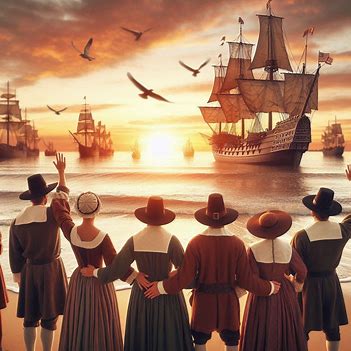
“The Puritans were strict Calvinists, or followers of the reformer John Calvin. Calvin taught that God was all-powerful and completely sovereign. Human beings were depraved sinners. God had chosen a few people, “the elect,” for salvation. The rest of humanity was condemned to eternal damnation. But no one really knew if he or she was saved or damned; Puritans lived in a constant state of spiritual anxiety, searching for signs of God’s favor or anger.”2
The Separatists believed the Church of England could not be reformed. The Puritans believed it could. I’m not taking sides as to which position is correct. All I want to point out is that they took a stand, accepting the consequences, and counting the cost to either separate to the New World immediately or to come 10 years later.
God calls us to take our stand for Him. Proverbs 1:10-16 says, “My son, if sinners entice thee, consent thou not. (11) If they say, Come with us, let us lay wait for blood, let us lurk privily for the innocent without cause: (12) Let us swallow them up alive as the grave; and whole, as those that go down into the pit: (13) We shall find all precious substance, we shall fill our houses with spoil: (14) Cast in thy lot among us; let us all have one purse: (15) My son, walk not thou in the way with them; refrain thy foot from their path: (16) For their feet run to evil, and make haste to shed blood.”
If we lived back in the days of the Church of England and the 17th century, we would be in the same predicament that the Separatists and the Puritans were in. Would we have sacrificed all and boarded the Mayflower with the Separatists? Would we have been willing to leave the security of our homeland in order to find a place where we could freely worship our Lord?
It could not be said better than what Joshua said in Joshua 24:15. “And if it seem evil unto you to serve the LORD, choose you this day whom ye will serve; whether the gods which your fathers served that were on the other side of the flood, or the gods of the Amorites, in whose land ye dwell: but as for me and my house, we will serve the LORD.”
1https://www.britannica.com/topic/Separatists
2https://www.pbs.org/wgbh/pages/frontline/godinamerica/people/puritans.html
Images are taken from https://pixabay.com/, https://www.pexels.com/, or https://unsplash.com/images or created in Windows Copilot. According to the websites, they are Royalty Free and free to be used for our purposes.
