

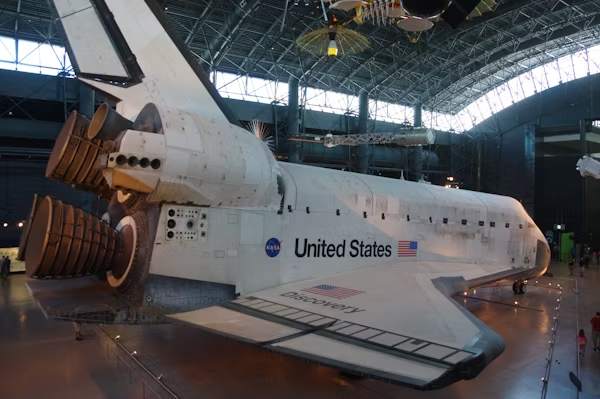
 Sometimes, the brutal honest truth is both devastating and disturbing. Such is the case with the two stories I share.
Do you remember where you were on Tuesday morning, January 28, 1986? At 11:38:00, the Space Shuttle Challenger lifted off from Cape Canaveral, Florida. At 11:39:13, the shuttle exploded before our eyes. Kids all across America were glued to their classroom televisions to watch schoolteacher Christa McAuliffe’s journey into space. Now, the wrong kind of image was forever emblazoned upon their minds.
As the investigation into the events proceeded, it was discovered that the cause of the explosion was primary and secondary O-ring seal failures on the solid rocket boosters due to cold temperatures and wind shear. And it all could have been prevented.
Two engineers tried to stop the launch, knowing that this wasn’t going to end well. The temperature at the Cape was going to be a record low. Ice had formed on the launch pad. The engineers stated that the O-rings would fail in such low temperatures but NASA ignored them, pressing for a launch that had already faced delays.
What was the hurry? “ As reported by the U.S. Committee on Science and Technology in October 1986, “NASA’s drive to achieve a launch schedule of 24 flights per year created pressure throughout the agency that directly contributed to unsafe launch operations.” The Committee also noted that even after the catastrophic launch, this “pressure to push” was still observed in other aspects of NASA’s operations, which led to safety concerns taking a backseat instead of being rightfully prioritized.”1
We learn from the past so that the same mistakes aren’t made, right? Just ask the crew of the spaceship Columbia that launched on February 1, 2003. Oh, wait … you can’t ask them because they’re all dead! Lessons had not been learned.
On January 16, 2003, Columbia launched from Kennedy Space Center. A mere 81.7 seconds into the flight, foam began coming off in chunks from the external tank, striking the shuttle’s left wing and causing damage. Watching footage of the launch, NASA saw this had happened and began assessing the damage. 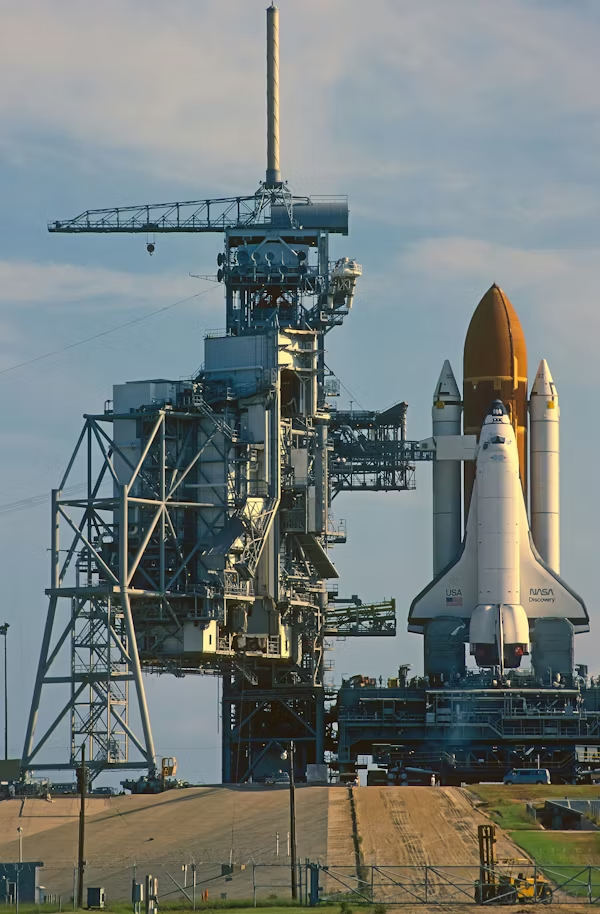
“On January 23, flight director Steve Stich sent an e-mail to Husband and McCool to tell them about the foam strike and inform them there was no cause for concern about damage to the TPS, as foam strikes had occurred on previous flights.
“During ascent at approximately 80 seconds, photo analysis shows that some debris from the area of the -Y ET Bipod Attach Point came loose and subsequently impacted the orbiter left wing, in the area of transition from Chine to Main Wing, creating a shower of smaller particles. The impact appears to be totally on the lower surface and no particles are seen to traverse over the upper surface of the wing. Experts have reviewed the high speed photography and there is no concern for RCC or tile damage. We have seen this same phenomenon on several other flights and there is absolutely no concern for entry.
“The crew were also sent a fifteen-second video of the debris strike in preparation for a press conference, but were reassured that there were no safety concerns.”2
Upon reentry on February 1, 2003 at 8:44:09, Columbia began experiencing failures, heating up rapidly both internally and externally before breaking apart. The last transmission was broken up at 8:59:32. At 9:00:18, catastrophic breakups of the shuttle began. By 9:35:00, all remains of debris and astronauts had hit the ground.
It has been determined through investigations that NASA knew the damage detached foam chunks could causes. One of their directors, Linda Ham, prevented better imagining of Columbia to assess the damage. The crew of Columbia were given a sterilized version of the damage leading them to believe that it was not nearly as serious as imagined. And, had the imaging been made, a rescue attempt could have been made with the spacecraft Atlantis which was ready for launch. If nothing else, the crew could have performed a dangerous space walk and repaired the shuttle themselves.
To know the truth but refusing to share it seems unconscionable. It’s equally disturbing that heads didn’t roll over this and that the American public becomes aware of it so long after the fact.
What does it say, then, about the Christian who knows the truth of the dangers ahead for the lost but never tells them, warning them to flee God’s eternal judgment and wrath?
Ezekiel 33:1-7 says, “Again the word of the LORD came unto me, saying, (2) Son of man, speak to the children of thy people, and say unto them, When I bring the sword upon a land, if the people of the land take a man of their coasts, and set him for their watchman: (3) If when he seeth the sword come upon the land, he blow the trumpet, and warn the people; (4) Then whosoever heareth the sound of the trumpet, and taketh not warning; if the sword come, and take him away, his blood shall be upon his own head. (5) He heard the sound of the trumpet, and took not warning; his blood shall be upon him. But he that taketh warning shall deliver his soul. (6) But if the watchman see the sword come, and blow not the trumpet, and the people be not warned; if the sword come, and take any person from among them, he is taken away in his iniquity; but his blood will I require at the watchman’s hand. (7) So thou, O son of man, I have set thee a watchman unto the house of Israel; therefore thou shalt hear the word at my mouth, and warn them from me.”
While we are not the watchmen in the sense of what Israel was given, there is still a similar mission. We know the truth. We are supposed to sound the alarm. And woe unto us if we don’t!
 I know that everyone makes their own decision either for or against the Lord. But the Christians will be held responsible for whether or not they sounded the alarm of warning. Let’s make certain that we are faithfully sounding the alarm, regardless if anyone will listen.
Colossians 1:25, 28 leaves us with this encouragement: “Whereof I am made a minister, according to the dispensation of God which is given to me for you, to fulfil the word of God… (28) Whom we preach, warning every man, and teaching every man in all wisdom; that we may present every man perfect in Christ Jesus.”
1https://www.grunge.com/197368/the-worst-part-of-the-space-shuttle-challenger-disaster-isnt-what-you-think/
2https://en.wikipedia.org/wiki/Space_Shuttle_Columbia_disaster#Flight_risk_management
Images are taken from https://pixabay.com/, https://www.pexels.com/, or https://unsplash.com/images or created in Windows Copilot. According to the websites, they are Royalty Free and free to be used for our purposes.
