

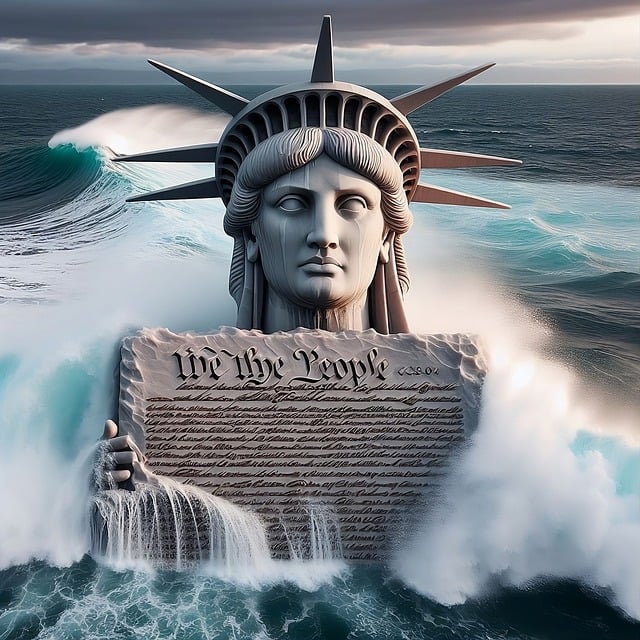
July 28, 1868. The 14th Amendment to the United States Constitution was adopted following its ratification. At the time, there were 37 states in the union. Amendments to the Constitution require three-fourths of the States to ratify the amendment. It took two years due to the opposition of President Andrew Johnson and Congress.
The amendment has five sections. Section 1 is what created the issue. It reads: All persons born or naturalized in the United States, and subject to the jurisdiction thereof, are citizens of the United States and of the State wherein they reside. No State shall make or enforce any law which shall abridge the privileges or immunities of citizens of the United States; nor shall any State deprive any person of life, liberty, or property, without due process of law; nor deny to any person within its jurisdiction the equal protection of the laws.1
After the Civil War, racism was rampant even though slavery had been abolished. The nation was fractured and bringing it back together was a monumental task. “Following a heated campaign between President Johnson and the Reconstruction Republicans over the future of the 14th Amendment, the Republican Party won a landslide victory in the congressional elections of 1866, solidifying their political power over Reconstruction policy.”2
It wasn’t until 1868 that 28 of the 37 states could be convinced to ratify the amendment. Confederate states were coerced into ratifying by being denied reentry into the Union unless they agreed. South Carolina was the 28th state to ratify after initially rejecting it. Eventually, all 37 states ratified the amendment. The 14th Amendment, though, was incapable of legislating racism into oblivion.
Racism still exists today in some places throughout the United States. Talking with a missionary friend, he told how there are locations in some Southern states where a black person is not welcome. However, this same missionary was in Jamaica and his family were the only white people. They were not accepted where they were serving, and it took years to establish a work.
Racism is nothing new and it existed in the Bible days. Jews hated Gentiles. Gentiles hated Jews.
Jews and Gentiles hated Samaritans. EVERYONE hated the Romans! Jesus did not directly address the racism. He certainly didn’t protest it, walking around with signs denouncing it. He didn’t appeal to the governmental powers to legislate a change. Instead, He addressed the real solution.
Colossians 3:9-11 says, “Lie not one to another, seeing that ye have put off the old man with his deeds; (10) And have put on the new man, which is renewed in knowledge after the image of him that created him: (11) Where there is neither Greek nor Jew, circumcision nor uncircumcision, Barbarian, Scythian, bond nor free: but Christ is all, and in all.”
1 John 3:15 and 4:20 says, “Whosoever hateth his brother is a murderer: and ye know that no murderer hath eternal life abiding in him…If a man say, I love God, and hateth his brother, he is a liar: for he that loveth not his brother whom he hath seen, how can he love God whom he hath not seen?” How can a person legitimately profess salvation while hating and despising someone else because of the color of their skin or their ethnicity? That goes contrary to the Word of God and the truth set forth by Jesus.
 Genuine salvation provides the only amendment needed to man’s hatred of his fellow man. Galatians 3:27-29 makes this clear. “For as many of you as have been baptized into Christ have put on Christ. (28) There is neither Jew nor Greek, there is neither bond nor free, there is neither male nor female: for ye are all one in Christ Jesus. (29) And if ye be Christ’s, then are ye Abraham’s seed, and heirs according to the promise.”
1https://constitution.congress.gov/constitution/amendment-14/
2https://constitutioncenter.org/blog/it-was-today-congress-approved-the-14th-amendment
Images are taken from https://pixabay.com/, https://www.pexels.com/, or https://unsplash.com/images or created in Windows Copilot. According to the websites, they are Royalty Free and free to be used for our purposes.
