

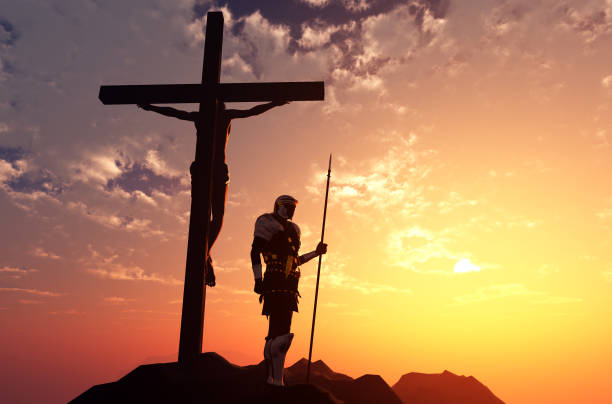
Crucified Jesus and the soldiers in the desert.,3d render
Today, we pick up where we left off yesterday by finishing the article written by Dr. Tommy Mitchell, a Fellow of the American College of Physicians and a speaker for Answers In Genesis. His assessment of the crucifixion comes from a medical doctor’s point of view and sheds light on what Jesus endured. The words are not for the squeamish or faint of heart. But the reality of Calvary needs to be seen from a fresh perspective so that we might grasp more fully the great love Jesus demonstrated on our behalf.
Blood and Water
“But one of the soldiers with a spear pierced his side, and forthwith came there out blood and water.” (John 19:34)
The water in this verse has generated much discussion among both the medical and the lay communities. Just what is the source of this water?
The blood is easy to explain. The soldier pierced Christ’s side with a spear. Although Scripture does not clearly say which side was penetrated, most believe this wound was in the chest because the Greek word used (pleura) refers to the thorax. Also, a killing thrust would most likely be delivered to the chest rather than the abdomen. So, the heart, pulmonary vessels, or even the aorta could be the source of the blood.
But what about the water? Some have suggested a miracle, but this explanation seems inadequate. If the water was a miracle, what was its purpose? How was God glorified though this event? No, a miracle seems unlikely.
This fluid may have come from around the lungs or around the heart. A spear piercing the side would pass through the pleural cavity, releasing any fluid that had accumulated there during this ordeal. Also, this killing thrust would most likely have been aimed at the heart (whether from the right or the left side), and thus would have entered the pericardial sac on its course. Perhaps a pericardial effusion was the source of the water described.
Some commentators have suggested that the water was actually ascites (fluid in the abdominal cavity) or even urine. This would require that the wound be in the abdomen, possibly piercing the bladder. While one cannot be dogmatic on this issue, the wording of the verse seems to indicate a wound to the chest. Therefore, the weight of evidence points away from the possibility of the abdomen.
Also, the wording of the verse does not necessarily mean that the blood was seen first. Often the word order indicates the prominence of one item over another. So, it is entirely possible that the volume of blood was much greater than the volume of water (which seems very likely), so blood is mentioned first.
The Cause of Death
Much has been written on the exact medical cause of Jesus’s death. The possibilities include cardiac rupture, asphyxiation, cardiac arrhythmia, and hypovolemic shock. However, a close examination of Scripture gives the proper answer to this question. John 10:17–18 tell us, Therefore doth my Father love me, because I lay down my life, that I might take it again. (18) No man taketh it from me, but I lay it down of myself. I have power to lay it down, and I have power to take it again. This commandment have I received of my Father.”
When Jesus had fulfilled all on the cross, John 19:30 tells us, “He said, It is finished: And He bowed His head, and gave up the ghost.”
It usually took two to five days for a person to die by crucifixion. Jesus died in only a few hours. Why the difference? The reason is simply that Jesus chose to die. He willingly gave up His life when His work was done.
I agree with Dr. Mitchell’s conclusion about Jesus’ cause of death. While He could have suffered any of the suggested medical conditions, there is no doubt that those things didn’t cause His death. When it was time, Jesus gave up His life willingly.
If the crucifixion wasn’t horrific enough, remember that the worst of Jesus’ suffering didn’t come from thorns, nails, bleeding, or any of the other parts of His torture. Isaiah 53:6 says, “All we like sheep have gone astray; we have turned every one to his own way; and the LORD hath laid on him the iniquity of us all.”
It’s impossible to imagine or fathom what this must have been like for Jesus. But we remember that Jesus did for us what was impossible for us or anyone else to do for us. And it was all because of His great love for us.
John 3:16 leaves us with these familiar but powerful words. “For God so loved the world, that he gave his only begotten Son, that whosoever believeth in him should not perish, but have everlasting life.”
https://answersingenesis.org/jesus/crucifixion/our-suffering-savior/
Images are taken from https://pixabay.com/, https://www.pexels.com/, or https://unsplash.com/images or created in Windows Copilot. According to the websites, they are Royalty Free and free to be used for our purposes.
