

 Strapped to many of our wrists is a watch. It’s become an accessory and is almost as important as remembering to put our pants on before leaving the house. In fact, in those times where I’ve walked out of the house without my watch, I’ve commented that I feel “naked” without it.
Do you ever wonder how we became so attached to our timepiece? If so, keep reading. If not – well, keep reading anyway!
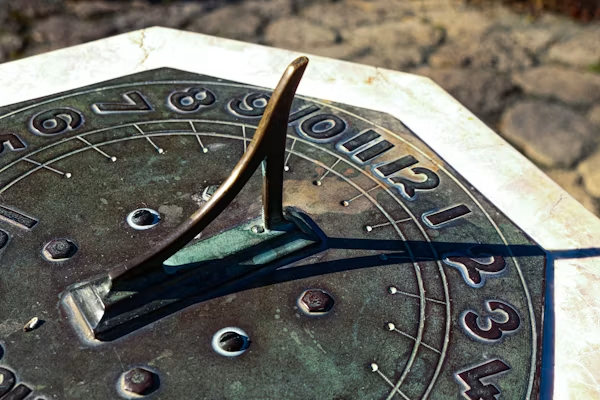
Keeping track of time has been done since the B.C. years by looking at the sun’s position, using a sundial, or water clocks. Mechanical clocks began to be developed in the 13th century, typically installed in towers or church belfries. By the 15th century, pocket watches had been developed, and the 17th century introduced the world to pendulum technology.
Wristwatches entered history during the late 19th century. Predominately worn as a woman’s accessory, men still relied on their pocket watches. WWI changed all that for men and by 1920, watches were worn by women and men.
During the 1960s, quartz technology once again revolutionized the watch making industry, providing superior accuracy. When purchasing a traditional watch today, the watch face might have the word “QUARTZ” stamped on it. Though we may not have understood what that meant, we intuitively believed that it was a better watch because of that word.1
As always, technology advances. Today, we have smart watches, capable of taking calls, displaying a calendar, sending/receiving text messages, and a whole lot more. Many, like mine, can take your blood pressure and perform an ECG. Like a smartphone, the smart watch comes complete with apps for a variety of needs. It’s a mini-computer strapped to the wrist.
In the Bible, the word “time” is mentioned 620 times with the first mention in Genesis 4:3. “And in process of time it came to pass, that Cain brought of the fruit of the ground an offering unto the LORD.” This wasn’t referencing hours, minutes, and seconds. Rather, it was dealing more with the passage of time. It’s like the usage of “hour” which appears 97 times in the Bible, typically referring not to the time on a clock but to a moment in time that was anticipated.
Ecclesiastes 3 gives the classic passage on “time.” The first two verses record, “To every thing there is a season, and a time to every purpose under the heaven: (2) A time to be born, and a time to die; a time to plant, and a time to pluck up that which is planted…” It refers to an event rather than the numbers on a timepiece.
“Time blindness” is the socially correct term to describe the person for whom time doesn’t mean much.2 They are chronically late to everything and unable to manage time. We will say that this person will be late to their own funeral. For those of us who are just the opposite and are extremely time conscious, those who are time blind drive us to new depths of frustration and panic. All the while, the time blind person is carefree and just skipping through life like the rest of the world should be totally fine to wait for them.
 If we thought it would help, we would buy them a watch – and set it 30-minutes fast!
Today is National Watch Day, established by Nordstrom as a way to celebrate the history of watchmaking. I’m sure that they wouldn’t be opposed to selling a few watches as a means to celebrate. Curiosity took me to their website and found that their most expensive watch was $8,000. That price is because of the diamonds in the band. However, if you’re really wanting to splurge on a watch that has no diamonds, you can go to the Luxe Digital website and purchase the Patek Philippe Grandmaster Chime Ref. 6300A-010. It will only cost you $31 – million.3
While you contemplate your next watch purchase, let’s allow the last Biblical reference to “time” to speak to us. Revelation 22:10 says, “And he saith unto me, Seal not the sayings of the prophecy of this book: for the time is at hand.”
1https://didyouknowscience.com/when-were-watches-invented-a-timeline-of-timekeeping-devices/
2https://www.psychologytoday.com/us/basics/time-blindness?msockid=3dbca97e8cba69b00490be188d786895
3https://luxe.digital/lifestyle/watches/most-expensive-watches/#Graff-Diamonds-Hallucination
Images are taken from https://pixabay.com/, https://www.pexels.com/, or https://unsplash.com/images or created in Windows Copilot. According to the websites, they are Royalty Free and free to be used for our purposes.
