

 Imagine how quickly your life can change. Such was the case for a young lawyer named Franklin.
In his early life, he had the best that money could buy. He was frequently taken throughout Europe where he developed the ability to speak German and French. He was athletic, participating in sailing, polo, tennis, golf, and horseback riding. A graduate of Harvard and Columbia Law School, his sights went higher than just being a lawyer. In fact, he really didn’t enjoy law. His interest was politics.
Franklin served as a New York state senator for three years before a six-year stint as the Assistant Secretary of the Navy. This was followed by a failed run as a vice president with presidential candidate James Cox, former governor of Ohio. From here, Franklin went back to practicing law.
On August 10, 1921, Franklin began feeling ill. Chills, nausea, and lower back pain were the first symptoms. By the next day, he had a fever and was experiencing weakness in one leg. By evening, the leg was paralyzed and the other leg was going weak.
In the days leading up to August 25, 1921, Franklin’s symptoms worsened. Numb legs gave way to extreme sensitivity where even a breeze across the skin caused excruciating pain. Paralysis set in, paralyzing not only the legs but also the bladder, bowels, and atrophy began setting into the hands. Then, on this day in 1921, the diagnosis was given. Poliomyelitis. Franklin Delano Roosevelt had polio.
Rehabilitation helped him develop his upper body strength. To walk even a small distance required the use of iron braces and a strong hold onto others by his side. This debilitation was severe, but it didn’t stop him from achieving lofty goals.
Roosevelt served two terms as governor for the state of New York. He then served as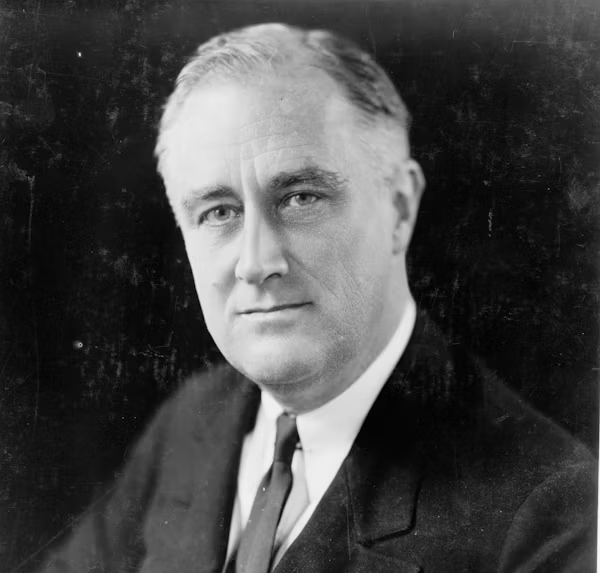 President of the United States from 1933-1945, the longest serving of any president. And his image is on the dime. Do you know why? Roosevelt founded The March of Dimes, an organization to help combat infantile polio.
The devotional isn’t about Roosevelt’s politics. It’s not about his well-documented immoral life. The point of the devotional is to highlight the fact that most people in Franklin’s condition would have never considered running for public office after such a diagnosis. Franklin travelled the world despite his physical limitations. He met with world leaders. He saw the United States through The Great Depression and WWII. A once virile, fit man has been reduced to a wheelchair and debilitation. But that didn’t stop him.
What’s YOUR excuse?
In Exodus 3:10-11, God said to Moses, “Come now therefore, and I will send thee unto Pharaoh, that thou mayest bring forth my people the children of Israel out of Egypt. (11) And Moses said unto God, Who am I, that I should go unto Pharaoh, and that I should bring forth the children of Israel out of Egypt?”
Jeremiah had the same response in Jeremiah 1:4-6. “Then the word of the LORD came unto me, saying, (5) Before I formed thee in the belly I knew thee; and before thou camest forth out of the womb I sanctified thee, and I ordained thee a prophet unto the nations. (6) Then said I, Ah, Lord GOD! behold, I cannot speak: for I am a child.”
Jonah didn’t even put up an argument. “Now the word of the LORD came unto Jonah the son of Amittai, saying, (2) Arise, go to Nineveh, that great city, and cry against it; for their wickedness is come up before me. (3) But Jonah rose up to flee unto Tarshish from the presence of the LORD, and went down to Joppa; and he found a ship going to Tarshish: so he paid the fare thereof, and went down into it, to go with them unto Tarshish from the presence of the LORD.” (Jonah 1:1-3)
 It’s too easy to come up with excuses as to why we can’t do something, especially something for the Lord. Thankfully, we have many examples of people who did not surrender to their disabilities, allowing them to become a liabilities. Instead, they learned to develop different abilities.
Don’t be guilty of making excuses. Take the attitude of Isaiah found in Isaiah 6:8. “Also I heard the voice of the Lord, saying, Whom shall I send, and who will go for us? Then said I, Here am I; send me.”
Images are taken from https://pixabay.com/, https://www.pexels.com/, or https://unsplash.com/images or created in Windows Copilot. According to the websites, they are Royalty Free and free to be used for our purposes.
