
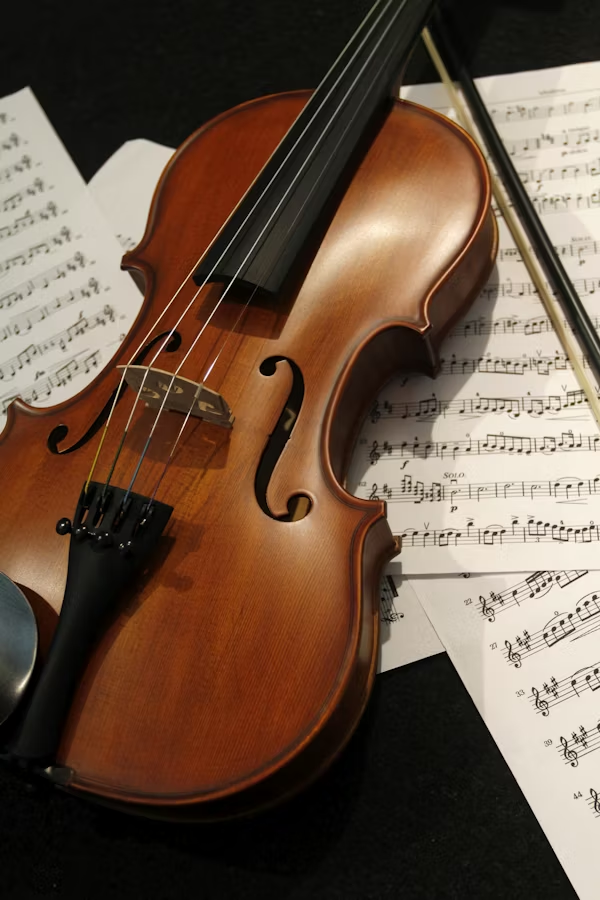
 As I was looking for a story to share, I ran across something that intersected with a special family birthday. Today, my dad would have been 87. It has been 12 years since dad went home to be with the Lord at the age of 74. One of the things dad always wanted to do was to play the violin. Today just so happens to be National Violin Day.
Typically, a violin has four strings, tuned to G, D, E, and A. However, much more advanced specialty violins can have from five to 12 strings. They also come in a variety of sizes: 4/4, 7/8, 3/4, 1/2, 1/4, 1/8, 1/10, 1/16, and 1/32. Determining the size needed depends on your age (for children) and the length of your left arm, measured from the nape of the neck to the end of the middle finger. The bow size corresponds to the size of the violin.1
“It is believed that Turkic and Mongolian horsemen from Inner Asia were the world’s earliest fiddlers. They played two-stringed upright fiddles strung with horsehair strings. Likewise, they played using horsehair bows and often featured a carved horse’s head at the end of the neck. The violins we play today (as well as the violas and cellos) with bows still strung with horsehair are a legacy of the nomads.”2
The age-long question for people who don’t play a violin is this: what’s the difference between a violin and a fiddle. The answer? Nothing. “The words fiddle and violin are two names for the same stringed instrument—fiddle is just an informal way of referring to the violin. In the context of classical music, it’s typically called a violin. In a bluegrass band, it’s more likely to be called a fiddle.”3 Those who play the fiddle will sometimes modify their violin with a flatter bridge.
There is one huge difference between the terms violin and fiddle. Call the typical violinist’s instrument a fiddle and they will correct you rapidly with a bit of indignation and an air of superiority. They do not debase themselves into the realm of country bluegrass and tend to find such a reference to be offensive. That’s not true, though, if you are Southern Raised.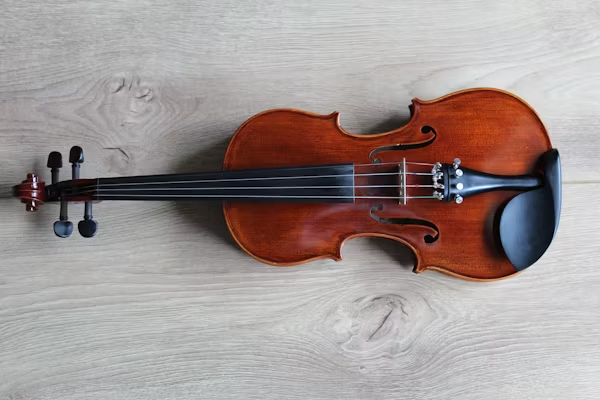
This is a group classically trained on violin, cello, and guitar who has fused it all with a very unique bluegrass sound. Add in the banjo and they are off and running! Their talent is remarkable and their sound is one you will never forget. Nobody in that group would be offended by “violin” or “fiddle” references.
While I don’t think there were modern-day violins in the Bible, there were definitely “stringed instruments.” Consider the makings of a holy orchestra found in Psalm Psalms 150.
“Praise ye the LORD. Praise God in his sanctuary: praise him in the firmament of his power. (2) Praise him for his mighty acts: praise him according to his excellent greatness. (3) Praise him with the sound of the trumpet: praise him with the psaltery and harp. (4) Praise him with the timbrel and dance: praise him with stringed instruments and organs. (5) Praise him upon the loud cymbals: praise him upon 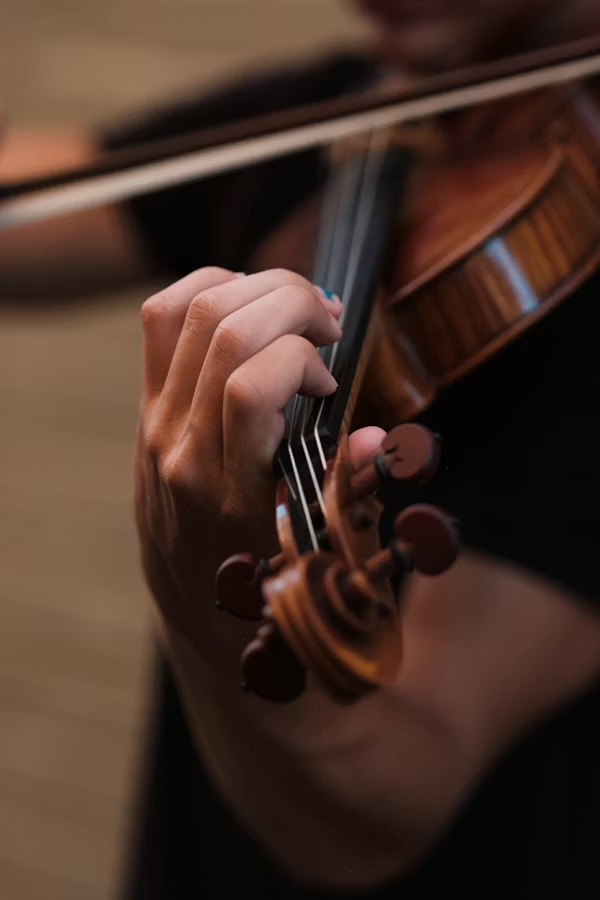 the high sounding cymbals. (6) Let every thing that hath breath praise the LORD. Praise ye the LORD.”
Eight instruments are specifically mentioned with “stringed instruments” paving the way for more. Psalms 33:2 names some of those. “Praise the LORD with harp: sing unto him with the psaltery and an instrument of ten strings.”
But we are missing one more instrument: our heart. I count 14 times that the word praise is used. From our hearts, the praise erupts from our lips as well as from instruments. Brass, woodwinds, and percussion fuse together in a joyful expression of praise to the Lord.
God has given us many ways to praise Him. I don’t think it matters so much what we use as much as it matters how we use it. We have to use it in a way that will glorify God.
Don’t wait for Sunday. Praise Him today.
“Make a joyful noise unto the LORD, all the earth: make a loud noise, and rejoice, and sing praise.” (Psalms 98:4)
1https://violinlounge.com/article/violin-size-chart-choose-the-right-size-violin/
2https://www.nationaldaycalendar.com/national-day/national-violin-day-december-13
3https://www.dictionary.com/e/fiddle-vs-violin/
Images are taken from https://pixabay.com/, https://www.pexels.com/, or https://unsplash.com/images or created in Windows Copilot. According to the websites, they are Royalty Free and free to be used for our purposes.
